Veterinary Endoscope Construction and Materials: Medical Grade Polymer and Stainless Steel Compliance
A veterinary endoscope is only as reliable as the materials it is built from. Working length, pixel count and bending angle matter — but they all sit downstream of a simpler question: what is the instrument actually made of, and can those materials be cleaned, reused and trusted across a realistic service life? Every model in the JeetVet range, from the 3.1 mm RAE-201 veterinary flexible otoscope to the 8.5 mm VET-8528 portable veterinary endoscope for large animals, is specified with the same material set: Plastic, Stainless Steel, Medical Grade Polymer and Optical Glass.
This article explains what each of those four materials does inside a veterinary endoscope, why medical grade polymer insulation and stainless steel shafts determine how safely an instrument can be cleaned and disinfected between patients, and how optical glass at the distal tip protects image quality. It closes with the material questions a buyer should put to any supplier — and the answers that should come back in writing.
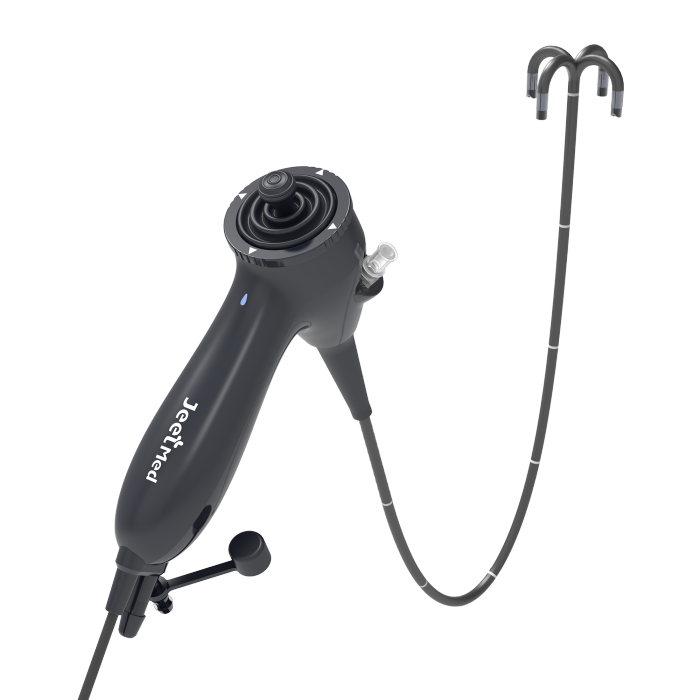
Why material questions decide whether an endoscope can be reused safely
Most veterinary endoscope evaluations begin with a specification sheet. Buyers compare outer diameters, working channels and resolution, then move straight to price. Material composition is often the last question asked — if it is asked at all. That order is backwards, because the failure modes that take an endoscope out of service are usually material failures rather than electronics failures.
- Hazy or scratched optics. A degraded distal window softens and distorts the image long before any electronic component fails, and by the time distortion is obvious the instrument has already produced unreliable examinations.
- Deformed or pitted shafts. A stainless steel insertion tube that has been kinked, dented or scratched loses pushability and becomes harder to clean thoroughly, because residue finds somewhere to sit.
- Ageing flexible sections. A polymer bending section that stiffens, swells or crazes after repeated cleaning cycles changes the bending geometry the clinician relies on.
- Fluid at housings and connectors. Trapped fluid in a seam or port is a maintenance problem and a hygiene problem at the same time.
All four outcomes are decided at the design stage, by which grade of polymer, which steel and which optical material a manufacturer chooses. In practice, material compliance is therefore a documentation exercise rather than a marketing phrase. It means knowing which material sits in which subassembly, what evidence the supplier can provide for it, and whether the finished instrument is declared reusable at all. JeetVet application data specifies an operation mode of continuous working for clinical use, reusable after sterilization — a statement that is only meaningful if the materials underneath it can survive the cleaning routine a clinic actually performs.
Veterinary instruments also work in conditions that laboratory equipment rarely faces. The documented operating envelope is 0 °C to 40 °C, storage between −10 °C and 55 °C, and relative humidity up to 80 % non-condensing, with use in veterinary clinics, animal hospitals and field environments, indoors and outdoors, including mobile veterinary services. A material that behaves predictably on a bench can behave very differently in a vehicle at the edge of that range.
The commercial context behind material scrutiny
Veterinary endoscopy has moved from a specialist procedure to a routine diagnostic category. Straits Research values the global veterinary endoscopy market at approximately USD 290 million to USD 300.72 million in 2024/2025, with projections above USD 586 million by 2034. Market Research Future reports that North America accounted for more than 34.48 % of global revenue as of 2024, and the North American Pet Health Insurance Association reports more than 5 million insured pets in North America as of 2024 — a driver that raises demand for advanced diagnostics such as endoscopy.
Market sizing should still be read with care. Research firms diverge noticeably on base-year valuations for this category, so a single market figure is best treated as a directional signal rather than a settled number. What does not diverge is the direction of procurement: buyers increasingly ask suppliers to document what an instrument is made of, not only what it can do.
Standards are part of that shift. The ISO 8600 series — ISO 8600-1 for general requirements and ISO 8600-3 for field of view — addresses optical safety and performance for medical endoscopes according to FDA consensus standards documentation. Requirements of that type are met or missed at the level of physical and optical design: window material, lens geometry and tube construction. Buyers should ask which standard set, if any, is declared for a specific veterinary model rather than assuming alignment.
On the supply side, Jeet Medical (Shenzhen) Co., Ltd., which manufactures under the JeetVet brand, is a manufacturer specializing in the research, development, design and manufacturing of advanced veterinary endoscopes and devices. Established in 2020, the company operates a 5,000 m² facility at 9th Floor, Block B, Building 1, No. 76 Baohe Avenue, Longgang District, Shenzhen, China, employing approximately 130 staff with a 30-engineer R&D team. Export sales account for 50 % of total sales, with major markets in Europe, North America, Southeast Asia, Latin America and the Middle East. The company states that it is certified under ISO 13485 by SGS. Key global competitors identified in market research include Karl Storz, Olympus Corporation, Eickemeyer and Fujifilm Holdings.
For a buyer, the practical consequence is straightforward: material selection is the point where cleanliness, reuse, service life and image quality intersect.
The four materials inside a veterinary endoscope — and what each one protects
From the 3.1 mm RAE-201 to the 8.5 mm VET-8528, JeetVet product data lists the same four material families. Each sits in a different part of the assembly and answers a different question about performance and reuse.
1. Optical glass: the distal window and lens elements
Optical glass is specified where image geometry is decided — the distal window and the lens elements behind it. The reason is dimensional stability. A glass window holds its curvature and surface quality better than a soft polymer window when it is wiped, flushed or exposed to cleaning agents, and image distortion in an endoscope can almost always be traced back to a window that no longer behaves like the one the optics were calibrated with.
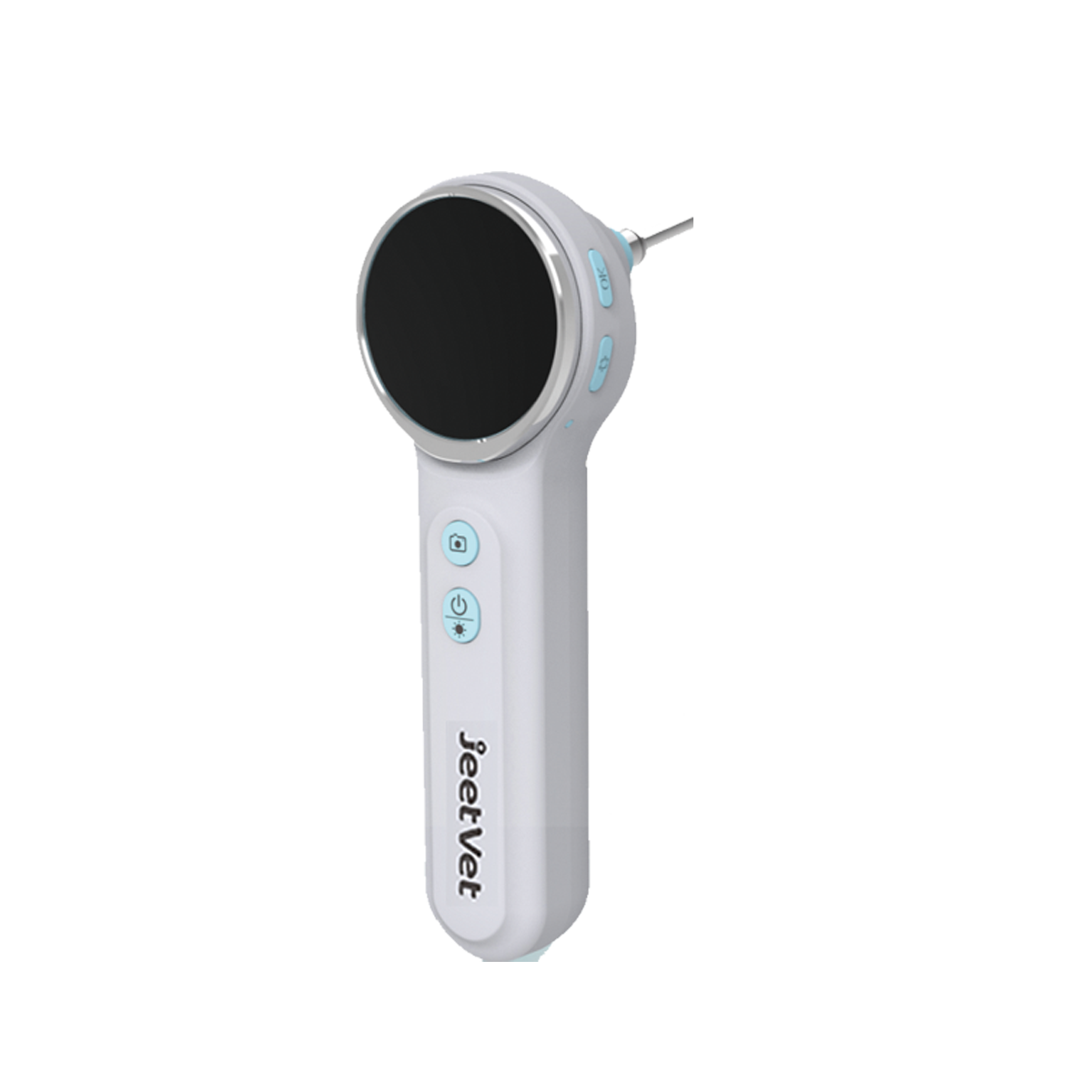
The optical specification depends on it. The RAE-201 flexible otoscope is listed with a 120° field angle, a 5 mm to 50 mm depth of field and 160,000 pixels — a short-working-distance configuration for ear and nasal examination. The RAE-105, RAE-105Pro, RAE-107 and RAE-109 endoscopes specify a 120° field angle with a 7 mm to 100 mm depth of field and 1,000,000 pixels. The VET-5820 and VET-8528 large-animal instruments specify a 120° field angle with a 7 mm to 100 mm depth of field and HD 1080P imaging. The RAE-500 smart otoscope uses a 78° field of view, a 3.9 mm lens, a 5 mm to 50 mm focal length and 720 × 720 pixel image and video resolution from a 1 MP camera.
Question to ask a supplier: what material forms the distal window, and is the imaging specification — field angle, depth of field, distortion behaviour — measured through that window after repeated cleaning, not only on a new unit?
2. Stainless steel: the insertion tube
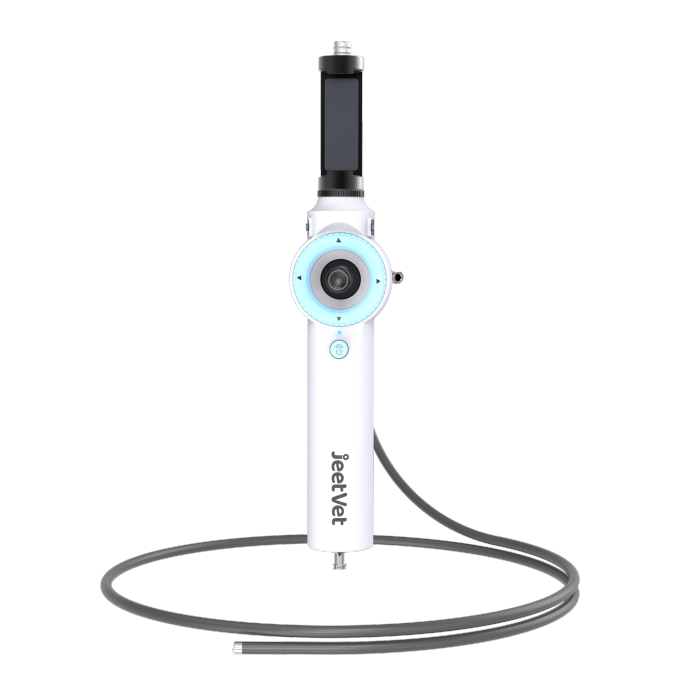
Stainless steel forms the shaft of the instrument. It provides the column strength that lets a clinician advance the endoscope through the gastrointestinal tract, the torque that lets the tip be steered, and the dimensional stability that keeps a thin tube from collapsing when it is flexed. Working length and diameter are quoted directly in the product specifications: the RAE-201 uses a 600 mm working length with a 3.1 mm outer tube diameter and a 1.2 mm inner channel; the RAE-107 uses 1000 mm with a 5.8 mm outer diameter and a 2.0 mm channel; the VET-5820 uses 1500 mm with a 5.8 mm outer diameter and a 2.0 mm channel; and the VET-8528 uses 1500 mm with an 8.5 mm outer diameter and a 2.8 mm channel.
The steel surface is also the surface that gets cleaned. A smooth, dimensionally stable tube can be wiped and disinfected predictably, whereas a tube that has been dented or scratched during handling gives residue somewhere to sit. Shaft condition should therefore be checked as part of the reprocessing routine, not only when a fault becomes visible on screen.
Question to ask a supplier: how is the shaft finished, and what handling damage — kinks, dents, scratches — disqualifies it from further clinical use?
3. Medical grade polymer: flexible sections and insulation
Medical grade polymer serves the parts of the assembly that must flex: above all the bending section, and the insulating layers that separate the instrument's internal electrical and optical components from the surfaces that contact the animal. In a flexible endoscope, that combination of flexibility and insulation is what allows a thin instrument to be steered deep into a body cavity while remaining safe to handle.
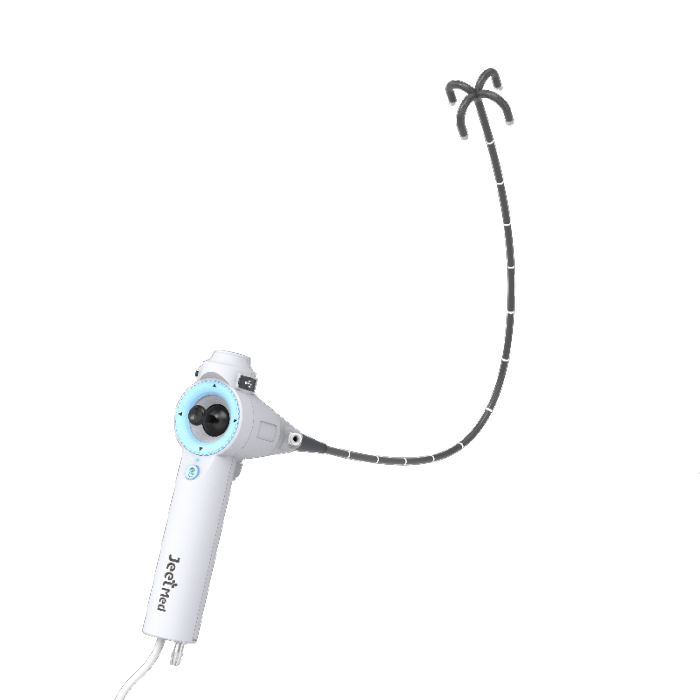
Bending performance is quoted directly in the product data. The RAE-201 deflects 180° in an up-and-down steering direction. The RAE-105, RAE-105Pro, RAE-109, VET-5820 and VET-8528 combine a 180° up-and-down and 180° left-and-right bend with 360° rotation or steering. The RAE-107 provides 360° directional control.
Every one of those movements is carried by the polymer section — and it is also the section exposed to cleaning and disinfection most often. A polymer grade selected for flexibility alone can stiffen, swell or craze over time; a grade selected for compatibility with the cleaning agents in use holds its bending geometry for longer, which is precisely what keeps a reusable instrument inside its declared performance window. This is why the reuse statement and the polymer specification should always be read together.
Question to ask a supplier: which polymer grade is used in the bending section, and which cleaning and disinfection agents has it been assessed against?
4. Plastic: housing, handle, connectors and screen assembly
Plastic components carry the human-facing parts of the instrument: handle and housing, connector interfaces and, on the RAE-500, the 1.85-inch screen assembly. That model uses a Type-C port, six LED lights, image magnification of 1×, 1.2× and 1.5×, and built-in 8 GB memory. Connectivity across the range is handled by USB and WiFi — the RAE-105Pro offers both, the RAE-107 is WiFi, and the RAE-105 and RAE-109 are USB — with compatibility across Android, Windows and iOS systems.
Housing material matters for two unglamorous reasons: impact resistance in field use, and the behaviour of seams and ports when the outer surface is wiped down. Fluid that reaches a connector is a maintenance issue and a hygiene issue at the same time, so the wipe-down boundary around the handle should be defined rather than assumed.
Question to ask a supplier: which parts of the housing and port area are cleanable, which are not, and what wipe-down guidance applies?
Material-to-function map: what to verify before you buy
| Material | Where it sits | What it protects | Question to ask the supplier |
|---|---|---|---|
| Optical glass | Distal window and lens elements | Image geometry: field angle, depth of field, freedom from distortion over repeated cleaning | What forms the distal window, and how is it cleaned? |
| Stainless steel | Insertion tube (shaft) | Column strength, steering, a stable outer diameter that can be cleaned predictably | How is the shaft finished, and what damage disqualifies it? |
| Medical grade polymer | Bending section and insulating layers | Bending geometry (180° / 360°) and insulation between internal components and the animal | Which polymer grade, and which cleaning agents were assessed? |
| Plastic | Housing, handle, connectors, screen assembly | Impact resistance, cleanable handle surfaces, port protection | Which areas are cleanable and which are not? |
A seven-step material review for veterinary buyers
- Request a material declaration by subassembly, not by product. “Medical grade” on a brochure tells a buyer very little. Ask for the material used in the distal window, the bending section, the insertion tube, the housing and the connector, so each claim can be checked against the part it describes.
- Separate patient-contact materials from cleaning-contact materials. The distal window, tube and bending section touch tissue; the housing and connectors touch hands, gloves and wipes. Different materials are judged on different criteria, and conflating them hides the parts that matter most.
- Check the imaging claim against the optical specification. Field angle, depth of field and resolution figures — 120° and 5–50 mm on the RAE-201, 120° and 7–100 mm with 1,000,000 pixels on the RAE-105 family, HD 1080P on the VET-5820 and VET-8528, 78° and 720 × 720 on the RAE-500 — should be explained in terms of the optical material that produces them.
- Match the shaft to the anatomy you actually examine. A 600 mm, 3.1 mm otoscope shaft and a 1500 mm, 8.5 mm large-animal shaft are different engineering problems. Selecting on price alone ignores the material demands of each configuration.
- Get the reuse and cleaning statement in writing. The relevant question is whether the instrument is reusable, and after which process. JeetVet application data specifies reuse after sterilization; the supplier should confirm the cleaning agents and reprocessing steps that the declared materials support.
- Validate on a single unit through your own routine. Material performance is only proven under the conditions a specific clinic uses. Clean and reprocess one instrument exactly as your team would in practice, then inspect the distal window, the bending section and the shaft for changes before committing to a wider purchase.
- File the documentation with the device record. Material declarations, reuse statements and relevant registrations belong with the equipment record so a later inspection or audit has something to reference. Where software components are involved, documentation extends beyond materials — the Jeet Medical Multi-Camera Automatic Fusion System V1.0, for example, holds a Computer Software Copyright Registration Certificate (No. 9413508) issued by CCPD, which applies to the China market.
Where material choices show up in everyday veterinary practice
Small animal ear and nasal examination
The RAE-201 veterinary flexible otoscope is designed for animal ear and nasal examination, with a 600 mm working length, a 3.1 mm outer tube diameter, a 1.2 mm inner channel, a 180° bending angle and an up-and-down steering direction. The small outer diameter is what makes the examination tolerable for a dog or cat, and the stainless steel tube is what keeps that diameter stable while the tip is steered. The same instrument family supports foreign body and mass removal, ear canal flushing, and biopsy or culture sampling to identify the cause of nasal discharge or obstruction.
Portable ear, nose and field examination
The RAE-500 portable smart otoscope packages a 1.85-inch screen, a 3.9 mm lens, a 78° field of view, six LED lights, 1× to 1.5× magnification and 8 GB of built-in storage into a handheld device. In a mobile practice, housing material and sealing around the Type-C port determine whether the instrument survives a vehicle-based working day as well as it survives a consulting room.
Small animal gastrointestinal and airway work
The RAE-105, RAE-105Pro and RAE-109 use a 5.8 mm outer diameter with a 2.0 mm working channel, 360° steering, a 180° up-and-down and left-and-right bend, a 7 mm to 100 mm depth of field and 1,000,000 pixels. The RAE-105Pro and RAE-109 weigh under 1 kg, and the RAE-107 adds WiFi connection with water and air supply, suction and a forceps working channel that a single veterinarian can operate. Documented clinical functions for this range include examining the duodenum for inflammatory bowel disease, tumours and blockages; visualising the trachea and bronchi for tracheal collapse, bronchitis, tumours and foreign bodies; supporting foreign body removal; and enabling minimally invasive procedures within a joint.
Large animal gastrointestinal examination
The VET-5820 portable veterinary gastroscope and the VET-8528 portable veterinary endoscope are built for large-animal work, both with a 1500 mm working length, a 180° bending angle and 360° rotation control. The difference is the shaft: 5.8 mm outer diameter with a 2.0 mm channel on the VET-5820, against 8.5 mm outer diameter with a 2.8 mm channel on the VET-8528. Both specify HD 1080P imaging, a 120° field angle and a 7 mm to 100 mm depth of field. Documented use includes biopsy, organ removal such as ovariectomy and splenectomy, and exploration of the abdominal cavity — procedures where a stable steel shaft and a polymer section that holds its bend are not optional.
Mobile and field services
Because the documented operating environment covers veterinary clinics, animal hospitals and field environments, indoors and outdoors, including mobile veterinary services, materials are selected against a wider temperature and humidity range than a hospital-only device would need: 0 °C to 40 °C operating, −10 °C to 55 °C storage, and up to 80 % relative humidity non-condensing. Documented application markets include the United States, Germany, the United Kingdom, France, Italy, Spain, Canada, Brazil, Mexico, the Netherlands, Australia, Malaysia, the Philippines, Turkey, Ukraine, the United Arab Emirates and Vietnam, among others.
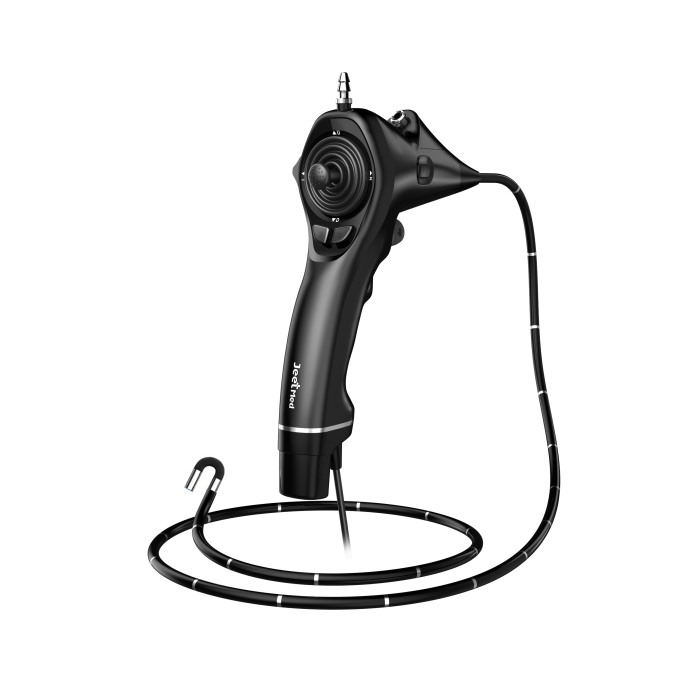
Model-by-model: geometry across the JeetVet range
Material specification stays constant across the range; geometry is what changes. Comparing models side by side makes it easier to see which material demand each configuration places on the instrument.
| Model | Type | Working length | Outer diameter | Working channel | Bending / rotation | Imaging |
|---|---|---|---|---|---|---|
| RAE-201 | Veterinary flexible otoscope | 600 mm | 3.1 mm | 1.2 mm | 180°, up & down steering | 160,000 pixels, 120° field angle, DOF 5–50 mm |
| RAE-500 | Portable smart veterinary otoscope | — | 3.9 mm lens | — | — | 720 × 720 px, 1 MP, 78° field of view, 6 LED lights |
| RAE-105 | Portable USB veterinary endoscope | — | 5.8 mm | 2.0 mm | 180° up/down & 180° left/right, 360° steering | 1,000,000 pixels, 120° field angle, DOF 7–100 mm |
| RAE-105Pro | Portable USB + WiFi veterinary endoscope | — | 5.8 mm | 2.0 mm | 180° up/down & 180° left/right, 360° steering | 1,000,000 pixels, 120° field angle, DOF 7–100 mm |
| RAE-107 | Portable WiFi veterinary endoscope | 1000 mm | 5.8 mm | 2.0 mm | 360° directional control | HD, 1,000,000 pixels, DOF 7–100 mm |
| RAE-109 | Portable USB veterinary gastroscope | — | 5.8 mm | 2.0 mm | 360° steering, 180° bend | 1,000,000 pixels, 120° field angle, DOF 7–100 mm |
| VET-5820 | Portable veterinary gastroscope for large animals | 1500 mm | 5.8 mm | 2.0 mm | 180° bending angle, 360° rotation control | HD 1080P, 120° field angle, DOF 7–100 mm |
| VET-8528 | Portable veterinary endoscope for large animals | 1500 mm | 8.5 mm | 2.8 mm | 180° bending angle, 360° rotation control | HD 1080P, 120° field angle, DOF 7–100 mm |
Every model listed above is specified with the same four-material set — plastic, stainless steel, medical grade polymer and optical glass. What changes is geometry: diameter, length, channel size and bending configuration. That is precisely what makes material documentation comparable across a range instead of a special case for one instrument.
Frequently asked questions
Which materials are specified in a JeetVet veterinary endoscope, and why does the material list matter?
JeetVet product data specifies the same four material families across the range: plastic, stainless steel, medical grade polymer and optical glass. They appear in different roles — optical glass at the distal window and lens elements, stainless steel in the insertion tube, medical grade polymer in the flexible bending section and insulating layers, and plastic in the housing, handle, connectors and screen assembly. The list matters because each material answers a different procurement question: whether the image stays sharp, whether the shaft keeps its shape, whether the flexible section survives repeated cleaning, and whether the handle can be wiped down.
Can a veterinary endoscope built with medical grade polymer and a stainless steel shaft be reused between patients?
Reuse is a declared property of the instrument, not an assumption. JeetVet application data specifies an operation mode of continuous working for clinical use, reusable after sterilization. That declaration sits on top of the material set: a stainless steel tube that retains its surface, and a polymer bending section that retains its flexibility, are what make repeated reprocessing realistic. Buyers should confirm in writing which cleaning and disinfection agents are supported for the specific model, and inspect the distal window, bending section and shaft as part of the routine.
How does optical glass prevent image distortion over the life of an instrument?
Optical glass is used at the distal window and in the lens elements because it holds its curvature and surface quality better than a soft polymer window under wiping, flushing and cleaning agents. Image geometry is set by that window: the RAE-201 pairs it with a 120° field angle and a 5–50 mm depth of field, the RAE-105, RAE-105Pro, RAE-107 and RAE-109 with 120° and 7–100 mm at 1,000,000 pixels, the VET-5820 and VET-8528 with 120° and 7–100 mm at HD 1080P, and the RAE-500 with a 78° field of view and a 3.9 mm lens. Distortion begins when the window stops behaving like the window the optics were calibrated with, which is why window material and window care are the same conversation.
Does a stronger material specification change what a veterinary endoscope programme costs?
Material decisions are best assessed across an instrument's usable service life rather than only at the point of purchase. The relevant question is how long the distal window, the shaft and the bending section stay within specification under your caseload and your cleaning routine, because that determines how often an instrument must be repaired or replaced. Buyers comparing quotations from different suppliers should request the same material declaration and the same reuse statement from each, so that price is compared against equivalent specifications rather than equivalent-looking brochures. Configuration-specific pricing is quoted per model, because the RAE-105, RAE-105Pro, RAE-107, RAE-109, RAE-500, VET-5820 and VET-8528 differ in tube diameter, working length and channel size.
How do buyers validate materials before committing, and how should lead time be handled?
Validation works best on a single unit. Request the material declaration and the reuse statement for the specific model, then clean and reprocess one instrument exactly as your team would in practice and inspect the distal window, the bending section and the shaft for changes. Model choice should follow the anatomy you examine: the RAE-201 for ear and nasal work at 3.1 mm and 600 mm, the RAE-107 at 1000 mm with WiFi and a 2.0 mm channel, and the VET-5820 or VET-8528 at 1500 mm for large-animal gastrointestinal examination. Lead time depends on configuration and order volume, so it should be confirmed in writing on the quotation rather than assumed from a catalogue page. To request product documentation, a configuration quotation or validation support, contact JeetVet at troy@jeetmed.com or +86 755-23251842 / +86 13381945549, or download the JeetVet veterinary endoscope brochure (PDF).
Conclusion
Material specification is the quiet variable in veterinary endoscope procurement. A 3.1 mm otoscope and an 8.5 mm large-animal endoscope are built from the same four material families — plastic, stainless steel, medical grade polymer and optical glass — but each material has to earn its place in a specific position, against a specific cleaning routine and a specific anatomy.
The practical rules are simple. Ask for material declarations by subassembly rather than by product. Read the reuse statement together with the polymer specification. Check the imaging claim against the optical window that produces it. Match shaft construction to the anatomy you actually examine. Validate the material set on one unit through your own cleaning routine, and keep the documentation with the device record so it is available when it is needed.
Buyers who evaluate veterinary endoscopes this way are not only comparing specifications. They are buying a predictable service life, a defensible cleaning process and an image that still tells the truth after the hundredth patient.
Next step: material documentation and a configuration quotation

Jeet Medical supplies material documentation, model specifications and configuration quotations across the JeetVet veterinary endoscope range, including the RAE-201, RAE-500, RAE-105, RAE-105Pro, RAE-107, RAE-109, VET-5820 and VET-8528.
- Download the product brochure: JeetVet veterinary endoscope brochure (PDF)
- Website: www.jeetvet.com
- Email: troy@jeetmed.com | Tel: +86 755-23251842 / +86 13381945549
- WhatsApp: 8613816158380 | WeChat: 13381945549
Tell us the anatomy you examine, the working length you need and the cleaning routine you use — that is the information required to match a material specification to your practice.

Jeet Medical (Shenzhen) Co., Ltd. — 9th Floor, Block B, Building 1, No. 76 Baohe Avenue, Longgang District, Shenzhen, China. Website: www.jeetvet.com.
Have Questions or Need More Details?
Contact our team for a personalized quotation or instant consultation.
Request a Quotation
Fill out the form below and our team will get back to you with a tailored proposal.
WhatsApp Direct Chat
Prefer to chat in real-time? Message us on WhatsApp for instant assistance & quick answers.
- Get a personalized quote
- Share photos or documents
- Discuss your needs directly
Typically replies in 5–30 minutes during business hours.