Veterinary Endoscope Partnership FAQ: Long-Term Supply, Acceptance & After-Sales
Veterinary Endoscope Partnership FAQ: Long-Term Supply, Acceptance & After-Sales
Short answer: a long-term veterinary endoscope partnership is decided by three things — whether the supplier's documentation can be verified, whether the model range actually covers the clinical work you do, and whether both sides have written down the same acceptance and after-sales expectations. Specifications decide which instrument fits which procedure. Documentation and written expectations decide whether the relationship still works in year three.
This FAQ is written for veterinary clinics, animal hospitals and veterinary endoscope distributors that have moved past discovery and are now evaluating suppliers in detail. It maps the models most often requested in 2026 — the RAE-107 portable WiFi endoscope, the RAE-109 USB gastroscope, the VET-5820 and VET-8528 large-animal scopes, and the RAE-201 and RAE-500 veterinary otoscopes — to common clinical needs, and it closes with the after-sales and long-term support questions buyers should settle in writing rather than assume.
1. Why Veterinary Endoscope Partnerships Stall After the First Order
An endoscope purchase is a transaction. A veterinary endoscope partnership is a set of expectations that has to survive staff changes, new case types and at least one instrument in service. Three failure patterns explain most of the friction that appears after the first order.
- Acceptance criteria that were never written down. If acceptance means a quick look through the optics, later disputes become a matter of opinion. Written criteria — imaging tier, bending range, working channel patency, sealing after sterilization, device connectivity — turn that opinion into a checklist that both sides can sign.
- Assumed model coverage. A 3.1 mm flexible otoscope for ear and nasal examination and an 8.5 mm large-animal endoscope with a 2.8 mm working channel are different instruments for different procedures, species and body sizes. Buyers who assume one platform covers everything usually buy twice.
- Verbal after-sales expectations. A statement of general support is not a service scope. The response channel, the escalation path and the documents a supplier will provide should be defined before the partnership starts, not after the first fault.
None of these gaps is a product defect, which is why the questions below focus on documentation, model-to-need mapping and written terms rather than on promotional language. It is also why questions such as which veterinary endoscope brand is best, or which manufacturers appear in a published list, are less useful than they first appear: brand recognition does not answer whether a 1080P large-animal gastroscope or a 160,000-pixel flexible otoscope fits the case in front of you.
2. Industry Background: Demand Growth and the Compliance Baseline
Veterinary endoscopy demand is rising, and the published numbers differ between research firms — a detail that matters for anyone writing a procurement justification.
- Straits Research values the global veterinary endoscopy market at approximately USD 290 million to USD 300.72 million in 2024/2025, with projections above USD 586 million by 2034.
- North America accounted for more than 34.48% of global revenue as of 2024, according to Market Research Future (MRFR).
- NAPHIA reports that more than 5 million pets were insured in North America as of 2024, a driver that supports wider adoption of advanced diagnostics such as endoscopy in small-animal practice.
- AI in endoscopy is accelerating at a CAGR of 25.7% (Technavio / Strategic Market Research), which is one reason the term AI veterinary otoscope appears in supplier marketing more often than in published specifications.
Base-year valuations diverge across sources: Mordor Intelligence estimates approximately USD 332.95 million for 2026, Data Insights Reports estimates USD 232.6 million for 2025, and Strategic Market Research quotes USD 1.2 billion for the broader endoscopy segment. For internal procurement documents, quoting a range with the source names attached is more defensible than quoting a single figure.
On the compliance side, medical endoscopes are generally expected to comply with the ISO 8600 series — ISO 8600-1 for general requirements and ISO 8600-3 for field of view — which address optical safety and performance. Mordor Intelligence identifies Karl Storz, Olympus Corporation, Eickemeyer and Fujifilm Holdings among the key global competitors in this market. That is useful context for competitive benchmarking; it is not a performance ranking, and brand size alone does not tell you whether an instrument suits a 6 kg cat or a 500 kg horse.
Buyer takeaway: treat market reports as a range, not a single truth, and treat compliance standards as questions to ask of every veterinary endoscope supplier — including the one you are already using.
3. What a Verifiable Partnership Looks Like: Documented Quality System and Model Range
Jeet Medical (Shenzhen) Co., Ltd., which manufactures under the JeetVet brand, is a veterinary endoscope manufacturer based in Shenzhen, China, founded in 2020. The company produces portable veterinary endoscopes, veterinary otoscopes, flexible veterinary otoscopes and veterinary gastroscopes.
3.1 First-party facts a distributor can verify
- Manufacturing facility of 5,000 m², with 130 employees and an annual output of 10,000 units.
- A 30-person R&D team.
- An export ratio of 50%, with main markets in Europe, North America, Southeast Asia, Latin America and the Middle East.
- ISO 13485 certification issued by SGS, supported by a 100,000-class cleanroom and a 10,000-class microbiological laboratory.
3.2 Compliance documents and what they cover
Beyond the ISO 13485 quality management system, the company holds Computer Software Copyright Registration Certificates issued by CCPD for the CN market:
- Certificate No. 9407860 for the Jeet Medical Multi-Light Source Vision Imaging System V1.0, issued 2022-02-25, valid to 2072-02-25. The Veterinary Endoscope RAE-201 is covered by this certificate.
- Certificate No. 9413508 for the Jeet Medical Multi-Camera Automatic Fusion System V1.0, issued 2022-03-10, valid to 2072-02-10.
These are software copyright registrations tied to the CN market and to specific imaging software versions. They are evidence of documented, registered software development, but they are not a substitute for market-specific device registration. Buyers evaluating a long-term veterinary endoscope partnership should confirm which documents apply in their own territory and request the current versions rather than photocopies from an earlier deal.
3.3 Portable endoscopes for small-animal work
The portable veterinary endoscope line connects over USB or WiFi to Android, Windows or iOS devices rather than requiring a dedicated video processor tower. That design choice is what most separates portable units from traditional console-based veterinary endoscope systems, and it directly affects how a clinic sets up and stores its equipment.
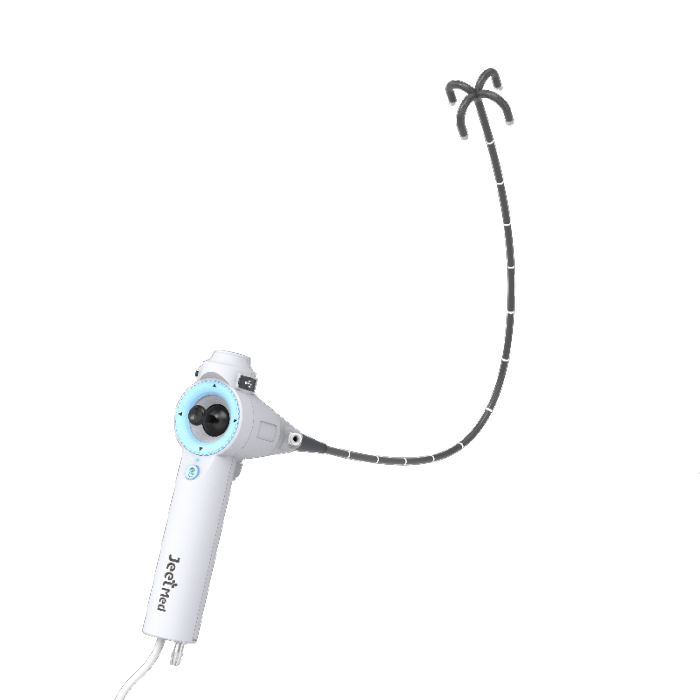
RAE-107 is a portable WiFi veterinary endoscope with 1,000,000 pixels, a 5.8 mm outer diameter, a 1000 mm working length and a 2.0 mm working channel. It offers 360° directional control, a 7 mm to 100 mm depth of field, WiFi connection, water and air supply, suction and a forceps working channel. It is also documented as operable by a single veterinarian, which matters for practices that cannot free a second pair of hands for every procedure.
RAE-109 is a portable USB veterinary gastroscope with 1,000,000 pixels, a 5.8 mm outer diameter, a 2.0 mm working channel and a 120° field angle. Its bending is 180° up and down plus 180° left and right, with 360° steering, a 7 mm to 100 mm depth of field, a weight under 1 kg and compatibility with Android, Windows and iOS. For clinics evaluating a veterinary gastroscope for pets, the 2.0 mm channel and 360° steering are usually the two specifications that decide whether the instrument is clinically usable.
RAE-105 and RAE-105Pro share the same core parameters — 1,000,000 pixels, 5.8 mm outer diameter, 2.0 mm working channel, 120° field angle, 7 mm to 100 mm depth of field and under 1 kg — with USB connection on the RAE-105 and USB plus WiFi on the RAE-105Pro.
3.4 Large-animal and equine endoscopy
Large-animal work is where tube length, not resolution alone, determines suitability.
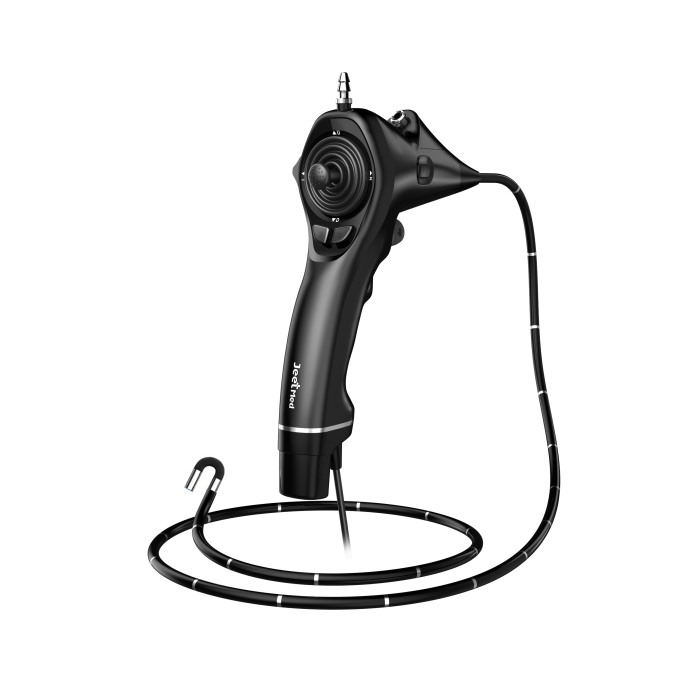
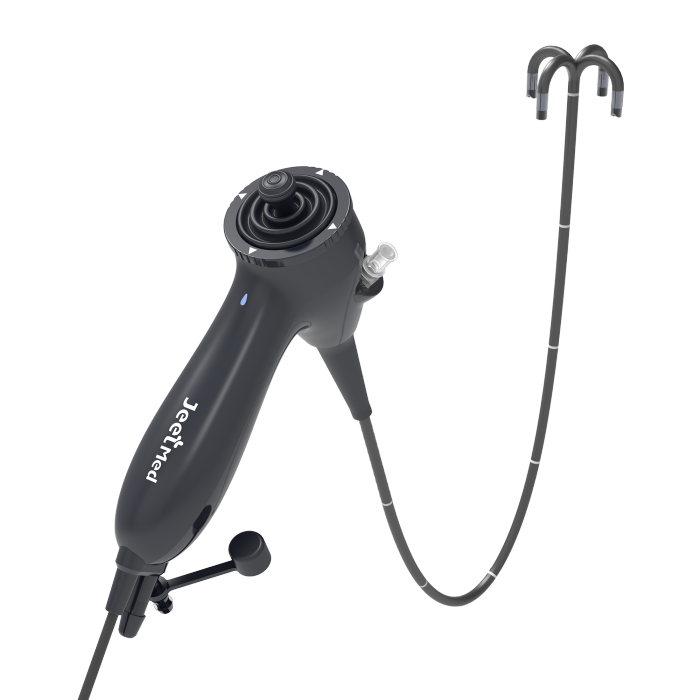
VET-5820 is a portable veterinary gastroscope designed for large animals and gastrointestinal examination, with a 1500 mm working length, a 5.8 mm outer diameter, a 2.0 mm inner channel, 180° bending, 360° rotation control, a 7 mm to 100 mm depth of field, a 120° field angle and 1080P imaging. VET-8528 is a portable veterinary endoscope for large animals with the same 1500 mm working length, 1080P imaging, 180° bending, 360° rotation and 7 mm to 100 mm depth of field, but with an 8.5 mm outer diameter and a wider 2.8 mm channel. The practical difference is accessory passage: the 2.8 mm channel accepts larger instruments than the 2.0 mm channel, while the 5.8 mm tube is easier to advance in a narrower lumen. For equine veterinary endoscope work in the field, the 1500 mm working length is the parameter that typically drives the choice.
3.5 Otoscopy: ear and nasal examination
Ear and nasal work needs a small diameter and short depth of field, not a long gastrointestinal tube.
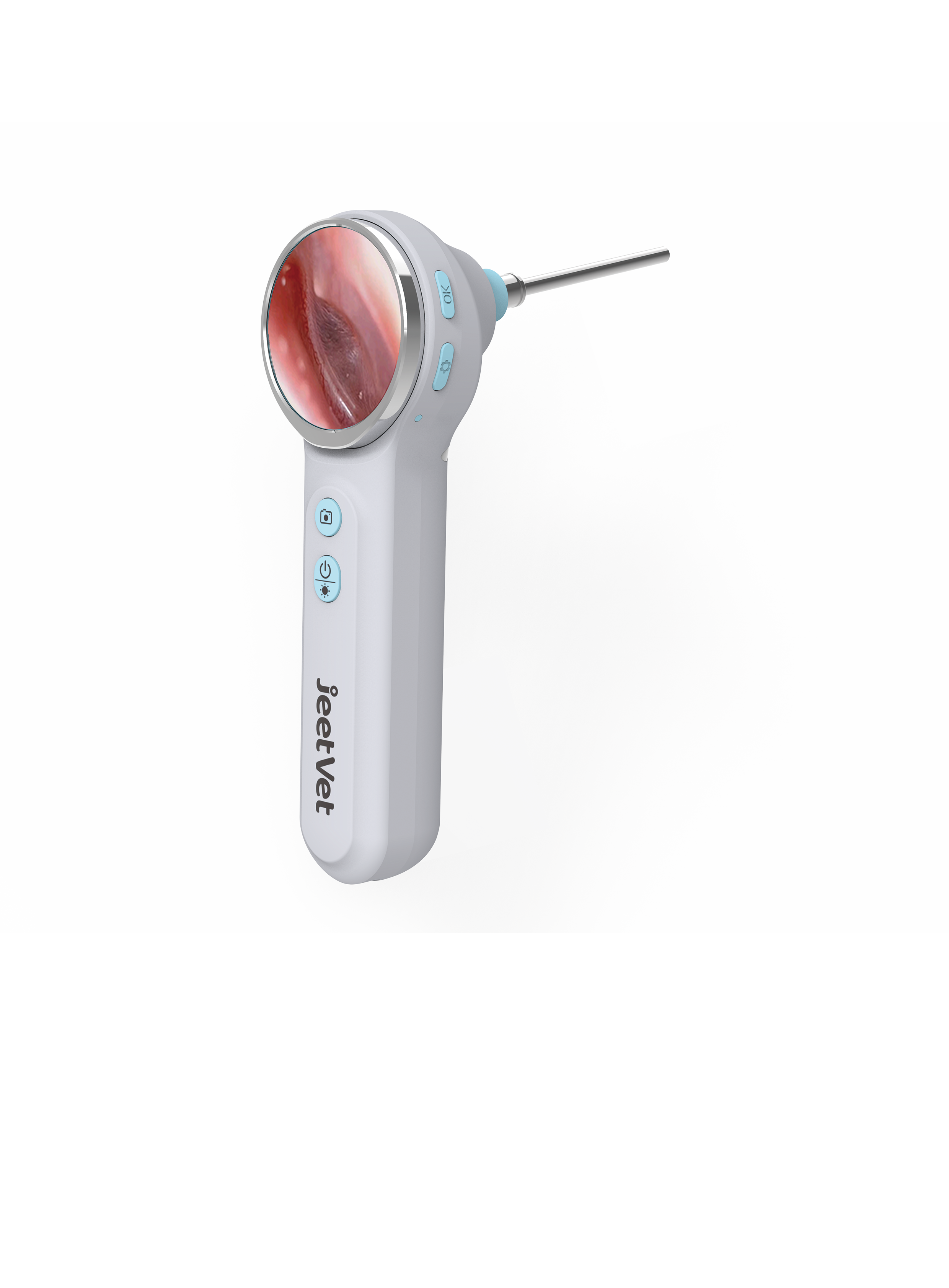
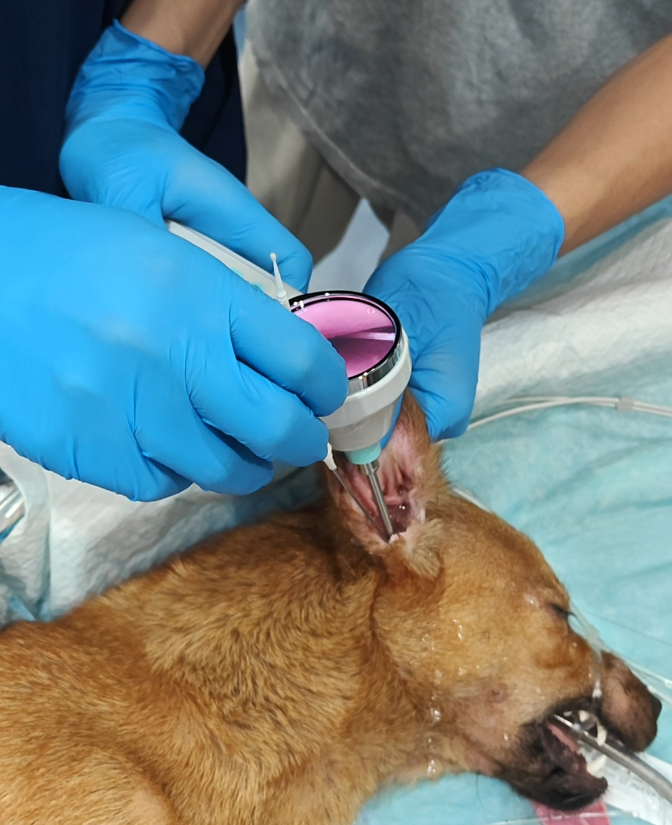
RAE-201 is a veterinary flexible otoscope for animal ear and nasal examination, with a 600 mm working length, a 3.1 mm outer diameter, a 1.2 mm inner channel, 180° bending, up and down steering, a 5 mm to 50 mm depth of field, a 120° field angle and 160,000 pixels. RAE-500 is a portable smart veterinary otoscope with a 1.85-inch screen, 720 x 720 pixel image and video resolution, a 3.9 mm lens, a 5 mm to 50 mm focal length, Type-C port, a 1 MP camera, 6 LED lights, 1x, 1.2x and 1.5x image magnification, a 78° field of view and built-in 8 GB memory. A digital veterinary otoscope of this type removes the need for a separate display, which is often the deciding factor for a single-veterinarian practice or a mobile service.
3.6 Shared construction and operating envelope
Across the range, the materials are listed as plastic, stainless steel, medical grade polymer and optical glass. The documented working conditions are an operating temperature of 0°C to 40°C, a storage temperature of -10°C to 55°C and a relative humidity of up to 80% non-condensing. The instruments are described as suitable for veterinary clinics, animal hospitals and field environments, for small and large animals, indoors and outdoors, including mobile veterinary services. Operation is continuous for clinical use, and the instruments are reusable after sterilization.
4. Step-by-Step Breakdown: How to Evaluate a Veterinary Endoscope Partner
The sequence below is designed so that each step produces a document you can attach to a supply agreement. Steps 1 to 3 are internal; steps 4 to 8 require the supplier to answer in writing.
- Define clinical scope by species and procedure. List the examinations you perform or intend to perform: gastrointestinal examination in dogs and cats, gastrointestinal examination in large animals, ear and nasal examination, and any biopsy or foreign-body work. This list, not a product brochure, determines which models are relevant.
- Convert scope into minimum specifications. For each procedure, set minimums for working length, outer diameter, working channel diameter, bending angle, field angle, depth of field and imaging tier. A routine ear case and a large-animal gastric case will produce very different minimums.
- Fix the acceptance tier before pricing. Decide whether you are buying a 160,000-pixel flexible otoscope, a 1,000,000-pixel portable scope or a 1080P large-animal scope. Mixing tiers across a multi-year plan is normal; leaving the tier undefined is what causes disputes.
- Request compliance documents by name. Ask for the ISO 13485 certificate issued by SGS, the CCPD software copyright registration certificates with their numbers and validity dates, and a statement of which standards such as ISO 8600-1 and ISO 8600-3 the optical system is assessed against. Ask which of these apply in your market.
- Confirm the model-to-need mapping in writing. A supplier should be able to state, for example, that VET-5820 has a 1500 mm working length and a 2.0 mm channel, while VET-8528 has a 1500 mm working length and a 2.8 mm channel. Vague answers here predict vague support later.
- Agree acceptance criteria before shipping. Include imaging tier, bending range, channel patency, sealing after sterilization, connectivity to your Android, Windows or iOS devices, and single-operator usability if that matches your staffing.
- Plan reprocessing and storage to the documented envelope. Confirm that your sterilization workflow matches the reusable-after-sterilization description, and that storage conditions stay within -10°C to 55°C and 80% relative humidity non-condensing.
- Write down the commercial and after-sales structure. Configuration, documentation pack, training expectations, contact channel and escalation path belong in the agreement. Do not treat a verbal warranty statement as a term of the partnership.
5. Use Cases: Matching Models to Clinical Scenarios
Small-animal gastrointestinal examination (dogs and cats). The 5.8 mm outer diameter and 1000 mm working length of the RAE-107, and the 5.8 mm diameter and 2.0 mm channel of the RAE-109, are the parameters that matter most here. RAE-107 adds WiFi, water and air supply, suction and documented single-veterinarian operation; RAE-109 uses USB and supports Android, Windows and iOS.
Equine and large-animal gastrointestinal examination. VET-5820 and VET-8528 both reach 1500 mm with 1080P imaging, 180° bending, 360° rotation and a 7 mm to 100 mm depth of field. Choose VET-5820 (5.8 mm outer diameter, 2.0 mm channel) when a narrower tube is the priority, and VET-8528 (8.5 mm outer diameter, 2.8 mm channel) when larger accessory passage is the priority.
Ear and nasal examination. RAE-201 provides a 3.1 mm outer diameter, a 1.2 mm channel and a 5 mm to 50 mm depth of field for flexible otoscopy, while RAE-500 provides a self-contained digital otoscope with a 1.85-inch screen, 1x to 1.5x magnification and 6 LED lights.
Field and mobile practice. A portable equine endoscope for field use has to travel without a console. In this range, portability is implemented through USB or WiFi connection to Android, Windows or iOS devices on models such as RAE-109, RAE-105 and RAE-105Pro, with instrument weights under 1 kg. Whether portable or traditional veterinary endoscope equipment is the better fit depends on caseload volume, mains power availability and whether a dedicated imaging cart is practical in your clinic layout.
Distributors building a portfolio. A veterinary endoscope distributor usually needs three tiers rather than one: an entry-level tier for affordable veterinary endoscope for small clinics positioning, a 1,000,000-pixel portable tier as the volume product, and a 1080P large-animal tier for referral hospitals and equine work.
6. Comparison Table: Model-to-Need Reference
The table below uses only documented product parameters. It is not a ranking, and models should be selected against your own clinical minimums from step 2 of the evaluation sequence.
| Model | Type | Working length | Outer diameter | Working channel | Imaging | Typical clinical fit |
|---|---|---|---|---|---|---|
| RAE-107 | Portable WiFi veterinary endoscope | 1000 mm | 5.8 mm | 2.0 mm | 1,000,000 pixels, HD | Small-animal work; single-veterinarian operation; suction, water and air supply available |
| RAE-109 | Portable USB veterinary gastroscope | Not specified in unit data | 5.8 mm | 2.0 mm | 1,000,000 pixels | Small-animal gastroscopy; 180° up/down and 180° left/right bending; under 1 kg |
| RAE-105 / RAE-105Pro | Portable USB / USB + WiFi veterinary endoscope | Not specified in unit data | 5.8 mm | 2.0 mm | 1,000,000 pixels | Volume portable tier; 120° field angle; Android, Windows, iOS |
| VET-5820 | Portable veterinary gastroscope for large animals | 1500 mm | 5.8 mm | 2.0 mm | 1080P | Large-animal and equine GI examination where a narrower tube is preferred |
| VET-8528 | Portable veterinary endoscope for large animals | 1500 mm | 8.5 mm | 2.8 mm | 1080P | Large-animal and equine GI examination where larger accessory passage is required |
| RAE-201 | Veterinary flexible otoscope | 600 mm | 3.1 mm | 1.2 mm | 160,000 pixels, 120° field angle | Ear and nasal examination; 5 mm to 50 mm depth of field |
| RAE-500 | Portable smart veterinary otoscope | Not applicable | 3.9 mm lens | Not applicable | 720 x 720 pixels, 1 MP camera | Digital otoscopy with 1.85-inch screen, 1x to 1.5x magnification, 8 GB storage |
The second table converts the same parameters into acceptance items that can be attached to a purchase agreement.
| Acceptance item | Documented reference in this range | How to verify before signing |
|---|---|---|
| Imaging tier | 160,000 pixels (RAE-201); 1,000,000 pixels (RAE-107, RAE-109, RAE-105, RAE-105Pro); 1080P (VET-5820, VET-8528); 720 x 720 pixels with 1 MP camera (RAE-500) | Compare live image output on the display you will actually use |
| Field angle | 120° on endoscope models; 78° on RAE-500 | Confirm the field angle figure for the exact model ordered |
| Depth of field | 5 mm to 50 mm (RAE-201, RAE-500 focal length); 7 mm to 100 mm (RAE-107, RAE-109, RAE-105, RAE-105Pro, VET-5820, VET-8528) | Test image sharpness at both ends of the stated range |
| Bending | 180° up and down; 180° left and right on RAE-109, RAE-105 and RAE-105Pro | Operate the full bending range on the delivered unit |
| Rotation control | 360° steering on RAE-107, RAE-109, RAE-105, RAE-105Pro, VET-5820 and VET-8528 | Check smooth rotation without binding |
| Working channel | 1.2 mm (RAE-201); 2.0 mm (RAE-107, RAE-109, RAE-105, RAE-105Pro, VET-5820); 2.8 mm (VET-8528) | Pass the accessories you intend to use |
| Connectivity | USB (RAE-109, RAE-105); USB and WiFi (RAE-105Pro, RAE-107); Android, Windows, iOS compatibility | Test with your clinic devices and network |
| Environment and reprocessing | 0°C to 40°C operating, -10°C to 55°C storage, up to 80% relative humidity non-condensing; reusable after sterilization | Confirm your sterilization and storage workflow matches the documented envelope |
7. Frequently Asked Questions
Q1. What certification documents should we verify before signing a long-term veterinary endoscope supply agreement?
Verify the ISO 13485 certificate issued by SGS for the quality management system, and request the Computer Software Copyright Registration Certificates by number and validity date: No. 9407860 for the Jeet Medical Multi-Light Source Vision Imaging System V1.0 (issued 2022-02-25, valid to 2072-02-25), which covers the Veterinary Endoscope RAE-201, and No. 9413508 for the Jeet Medical Multi-Camera Automatic Fusion System V1.0 (issued 2022-03-10, valid to 2072-02-10); both are issued by CCPD and apply to the CN market. In parallel, ask how the optical system is assessed against the ISO 8600 series, specifically ISO 8600-1 for general requirements and ISO 8600-3 for field of view. Because software copyright registration is market-specific, confirm in writing which documents apply to your territory before the agreement is signed.
Q2. Can one veterinary endoscope cover both small-animal and large-animal work?
No single model in this range covers both, because working length and tube diameter pull in different directions. Small-animal work is served by 5.8 mm instruments: RAE-107 with a 1000 mm working length, 2.0 mm channel and 360° directional control, and RAE-109 with a 5.8 mm outer diameter, 2.0 mm channel, 180° up/down and 180° left/right bending and 360° steering. Large-animal and equine work is served by the 1500 mm models: VET-5820 with a 5.8 mm outer diameter and 2.0 mm channel, and VET-8528 with an 8.5 mm outer diameter and 2.8 mm channel, both with 1080P imaging, 180° bending, 360° rotation control and a 7 mm to 100 mm depth of field. Ear and nasal work is a separate category again, covered by RAE-201 at 3.1 mm outer diameter and RAE-500 as a self-contained digital otoscope.
Q3. How should we budget for a multi-year endoscope partnership when no public price list exists?
Budget from configuration rather than from a headline price, because cost is driven by four documented variables: imaging tier, working length, tube and channel diameter, and connectivity. A 160,000-pixel flexible otoscope such as RAE-201, a 1,000,000-pixel portable scope such as RAE-109 and a 1080P 1500 mm scope such as VET-5820 sit in different cost bands by design, and USB versus USB plus WiFi is a further variable between RAE-105 and RAE-105Pro. A practical multi-year budget therefore has three lines: a flexible otoscopy line for routine ear and nasal cases, a portable 1,000,000-pixel line as the volume product, and a 1080P large-animal line for referral or equine work, plus accessories and consumables. Because no figures are published, the reliable route is to request a written quotation against your own model list.
Q4. What should a sample evaluation actually test before we commit?
Test the sample against the written specifications rather than against first impressions. Confirm the stated imaging tier on the display you will use; operate the full 180° bending range, and the 180° left/right range where applicable; confirm the 360° steering on RAE-107, RAE-109, RAE-105, RAE-105Pro, VET-5820 and VET-8528; pass the accessories you plan to use through the 1.2 mm, 2.0 mm or 2.8 mm channel; check image sharpness at both ends of the 5 mm to 50 mm or 7 mm to 100 mm depth of field; verify connectivity on Android, Windows or iOS devices; and confirm whether single-veterinarian operation, documented for RAE-107, matches your staffing. Record each result and attach it to the acceptance criteria — the sample evaluation is the evidence, not the conversation.
Q5. How should we plan long-term supply, lead time and after-sales expectations?
Plan from documented capacity and documented contact points rather than from verbal assurances. The facility is 5,000 m² with 130 employees and an annual output of 10,000 units, supported by a 30-person R&D team and a 50% export ratio across Europe, North America, Southeast Asia, Latin America and the Middle East — figures that let a distributor size a rolling order plan and ask for a written schedule instead of a verbal delivery estimate. Storage and transport planning should follow the documented envelope of -10°C to 55°C and up to 80% relative humidity non-condensing, with an operating range of 0°C to 40°C, and reprocessing procedures should be aligned with the reusable-after-sterilization description in your own standard operating procedures. For after-sales, define the response channel, escalation path and scope of support in the agreement; service terms should be written into the contract rather than assumed. To start that conversation, request a quotation and the current product catalogue by email at troy@jeetmed.com or jeetvet66@gmail.com, by phone at +86 755-23251842, or on WhatsApp at +86 13816158380. The full catalogue is also available as a downloadable PDF.
Next Step: Build Your Partnership Checklist With Us
Send your clinical scope — species, procedures, working length and channel requirements — and we will return a model-to-need mapping, the available compliance documents, and a written quotation for a single unit or a multi-year distribution plan.
Email: troy@jeetmed.com | Phone: +86 755-23251842 | WhatsApp: +86 13816158380
Website: www.jeetvet.com | Blog: blog.jeetvet.com | Download the product catalogue (PDF)
8. Conclusion
A veterinary endoscope partnership is not won by the widest product list. It is won by a documented quality system, a model range whose parameters match defined clinical needs, and acceptance and after-sales expectations that both sides have written down. In this range, the parameters that carry the most decision weight are working length (600 mm, 1000 mm or 1500 mm), outer diameter (3.1 mm to 8.5 mm), working channel (1.2 mm, 2.0 mm or 2.8 mm), bending (180°), rotation control (360°) and imaging tier (160,000 pixels, 1,000,000 pixels or 1080P) — supported by an ISO 13485 certification issued by SGS and CCPD software copyright registrations No. 9407860 and No. 9413508 for the CN market.
The practical sequence is unchanged: define scope, set minimum specifications, fix the acceptance tier, request documents by name, confirm the model mapping in writing, agree acceptance criteria before shipping, plan reprocessing and storage to the documented envelope, and put the commercial and after-sales structure into the agreement. Buyers who do that before the first purchase order rarely need this FAQ again in year three.
Jeet Medical (Shenzhen) Co., Ltd. manufactures veterinary endoscopes under the JeetVet brand at 9th Floor, Block B, Building 1, No. 76 Baohe Avenue, Longgang District, Shenzhen, China.
Have Questions or Need More Details?
Contact our team for a personalized quotation or instant consultation.
Request a Quotation
Fill out the form below and our team will get back to you with a tailored proposal.
WhatsApp Direct Chat
Prefer to chat in real-time? Message us on WhatsApp for instant assistance & quick answers.
- Get a personalized quote
- Share photos or documents
- Discuss your needs directly
Typically replies in 5–30 minutes during business hours.