Choosing the Right Veterinary Endoscope for Ear vs. GI Exams
Ear and nasal examination and gastrointestinal examination place opposite demands on a veterinary endoscope. Otoscopy needs a slim insertion tube that resolves detail at short range; GI examination needs working length, a usable instrument channel and enough bending range to follow the tract. Choosing one configuration for both exams — or choosing on price alone — is where most selection errors start, and the mismatch is visible in the datasheet long before it is felt in the examination room.
JeetVet is the veterinary endoscope brand of Jeet Medical (Shenzhen) Co., Ltd., a Shenzhen-based manufacturer of portable veterinary endoscopes, veterinary otoscopes, veterinary flexible otoscopes and veterinary gastroscopes. This guide places the RAE-201 flexible otoscope and the RAE-500 smart otoscope head to head against the RAE-109 USB gastroscope, the VET-5820 large-animal gastroscope and the VET-8528, and closes with a selection matrix built around four decision factors: patient size, target anatomy, mobility and single-veterinarian operation.

JeetVet brand mark — Jeet Medical (Shenzhen) Co., Ltd., manufacturer of portable veterinary endoscopes, otoscopes and gastroscopes.
Problem Definition: Why Ear/Nasal and GI Exams Cannot Share One Configuration
Four specifications decide which exam a veterinary endoscope configuration can serve: working length, outer tube diameter, working channel and depth of field. For ear and nasal examination, the RAE-201 is specified with a 600 mm working length, a 3.1 mm outer tube, a 1.2 mm working channel, a 5–50 mm depth of field and a 120° field angle. For gastrointestinal examination in large animals, the VET-5820 is specified with a 1,500 mm working length, a 5.8 mm outer tube, a 2.0 mm working channel, a 7–100 mm depth of field and a 120° field angle.
- Working length sets how deep the scope can reach. 600 mm covers the depth of an ear canal and nasal passage (RAE-201); 1,500 mm is the specification used for reaching into the gastrointestinal tract of large animals (VET-5820, VET-8528).
- Outer tube diameter sets which routes the instrument can physically enter. 3.1 mm is the tube diameter specified for ear and nasal examination; 5.8 mm is the insertion tube on the RAE-109, RAE-105, RAE-105Pro, RAE-107 and VET-5820; 8.5 mm is the insertion tube on the VET-8528.
- Working channel sets what can travel through the scope alongside the camera. 1.2 mm on the RAE-201; 2.0 mm on the RAE-109, VET-5820 and RAE-107; 2.8 mm on the VET-8528.
- Depth of field sets the range in which the image is usable. 5–50 mm keeps the focal range short for otoscopic detail; 7–100 mm is the GI specification.
The consequence is practical rather than theoretical. A practice that standardises on a long, thick gastroscope will find the insertion tube and working length mismatched to routine ear work, while a practice holding only a 3.1 mm flexible otoscope cannot use it for gastrointestinal examination in large animals, because neither the working length nor the depth of field reaches the target. The two scenarios are complementary purchases, not competing options.
Industry Background: What Is Shaping Veterinary Endoscope Selection in 2026
Veterinary endoscopy remains a growing but relatively concentrated category, and the published numbers explain why configuration choice is becoming a routine clinical decision rather than a specialist one. The global veterinary endoscopy market was valued at approximately USD 290M–300.72M in 2024/2025, with projections reaching over USD 586M by 2034 (Straits Research). North America accounted for over 34.48% of global revenue as of 2024 (Market Research Future).
- Demand driver. More than 5 million pets were insured in North America as of 2024 (NAPHIA), a metric that tracks the willingness of owners to pay for advanced diagnostic procedures such as endoscopy.
- Technology driver. AI in endoscopy is accelerating at a CAGR of 25.7%, and AI-assisted diagnostics is identified as a primary trend for veterinary systems (Technavio / Strategic Market Research). Imaging software and image quality therefore compete for attention alongside tube mechanics.
- Supplier landscape. The established global competitor set includes Karl Storz, Olympus Corporation, Eickemeyer and Fujifilm Holdings (Mordor Intelligence). Portable USB- and WiFi-connected systems compete on a different axis from cart-based towers: deployment flexibility, single-operator use and cost structure at the level of the individual examination.
- Standard reference. ISO 8600-1 covers general requirements for medical endoscopes and ISO 8600-3 addresses field of view. That is why field angle — 120° on the RAE-201, VET-5820 and VET-8528, and 78° field of view on the RAE-500 — is a specification worth locating on any datasheet you compare.
For buyers who are already past discovery and into evaluation, the practical implication is that scenario fit outweighs brand rank. An ear-and-nasal configuration and a GI configuration are different products with different specification sets, and many practices eventually need both.
Detailed Solution: Two Clinical Scenarios, Two Specification Sets
The JeetVet range splits cleanly along the ear/nasal and gastrointestinal boundary, with portable formats available in both groups.
Ear and nasal examination: RAE-201 flexible otoscope and RAE-500 smart otoscope
The RAE-201 Veterinary Flexible Otoscope is specified for animal ear and nasal examination. Its working length is 600 mm, the outer diameter of the tube is 3.1 mm, the inner diameter of the channel is 1.2 mm, the bending angle is 180°, the steering direction is up and down, depth of field is 5–50 mm, field angle is 120° and pixels are 160,000. The material set is plastic, stainless steel, medical grade polymer and optical glass.
Two of those numbers do most of the work. A 3.1 mm tube keeps the insertion diameter small for the ear canal and nasal route, and the 5–50 mm depth of field holds the focal range where otoscopic targets actually sit. The 1.2 mm channel is what separates an inspection-only otoscope from one that can support flushing or sampling during the same examination.
The RAE-500 Portable Smart Veterinary Otoscope takes a different route: it is a self-contained digital unit. Screen type is 1.85 inches, image and video resolution is 720 × 720 pixels, the diameter of the lens is 3.9 mm, focal length is 5–50 mm, ports are Type-C, the camera is 1 megapixel with 6 LED lights, image magnification is 1x, 1.2x and 1.5x, field of view is 78°, and storage capacity is built-in 8 GB memory. Because screen and storage sit on the instrument, an ear examination can be documented without a laptop, external monitor or capture software — a meaningful difference for mobile calls and for clinics that want images in the record with minimal setup time.
Gastrointestinal examination: RAE-109, VET-5820, VET-8528 and RAE-107
Four configurations cover the GI side of the range. They are distinguished mainly by working length, tube diameter, channel size and connection type.
- RAE-109 — Portable USB Veterinary Gastroscope. Steering 360°, outer diameter 5.8 mm, 1,000,000 pixels, angle of bend up and down 180° and left and right 180°, angle of field 120°, working channel 2.0 mm, depth of field 7–100 mm, weight under 1 kg, USB connection, compatible with Android, Windows and iOS.
- VET-5820 — Portable Veterinary Gastroscope for Large Animals. Purpose: animal gastrointestinal examination. Working length 1,500 mm, tube outer diameter 5.8 mm, channel inner diameter 2.0 mm, bending angle 180°, rotation control 360°, depth of field 7–100 mm, field angle 120°, imaging 1080P.
- VET-8528 — Portable Veterinary Endoscope for Large Animals. The same 1,500 mm working length and 1080P imaging, with an 8.5 mm tube outer diameter and a 2.8 mm channel for larger instrumentation.
- RAE-107 — Portable WiFi Veterinary Endoscope. Working length 1,000 mm, outer diameter 5.8 mm, working channel 2.0 mm, 1,000,000 pixels with HD image resolution, 360° directional control, depth of field 7–100 mm, WiFi connection, water and air supply with suction, forceps working channel and single-veterinarian operation all listed as available.
Read as a set, the GI configurations answer three different questions. The RAE-109 answers “can I start GI endoscopy using a device I already own?” through its USB connection to Android, Windows or iOS hardware. The VET-5820 answers “can I reach the full depth of a large animal gastrointestinal tract?” with a 1,500 mm working length and 1080P imaging. The VET-8528 answers “can I pass larger instruments?” with a 2.8 mm working channel.
Diagnostic value in all of these models also depends on the imaging and illumination software layer. Jeet Medical holds software copyright registration certificates issued by CCPD (Copyright Protection Center of China) for the imaging platforms referenced across this product family: the Jeet Medical Multi-Camera Automatic Fusion System V1.0, certificate No. 9413508, issued 2022-03-10 with validity to 2072-02-10, and the Jeet Medical Multi-Light Source Vision Imaging System V1.0, certificate No. 9407860, issued 2022-02-25 with validity to 2072-02-25.
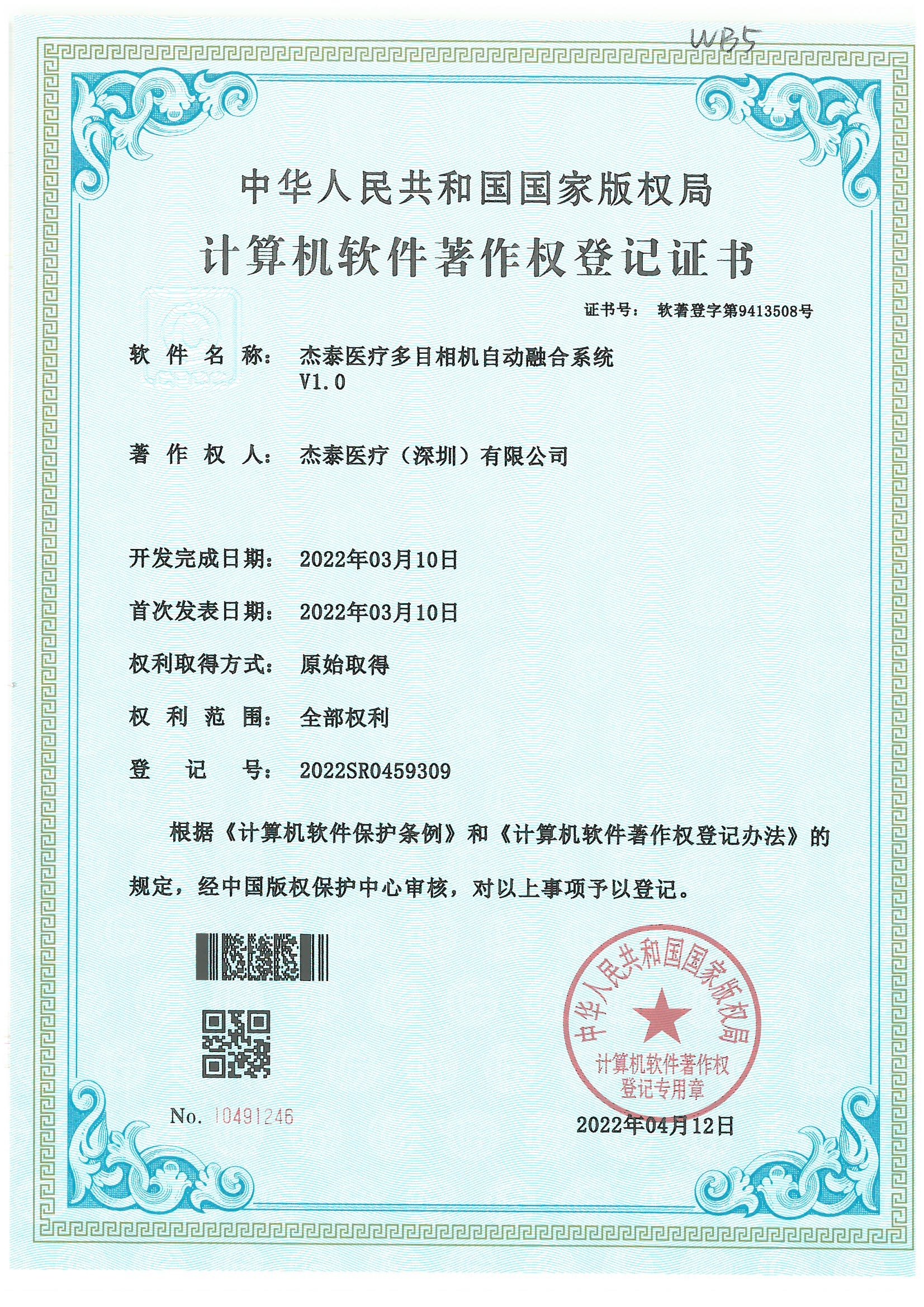
CCPD software copyright registration certificate for the Jeet Medical Multi-Camera Automatic Fusion System V1.0 (No. 9413508, issued 2022-03-10).
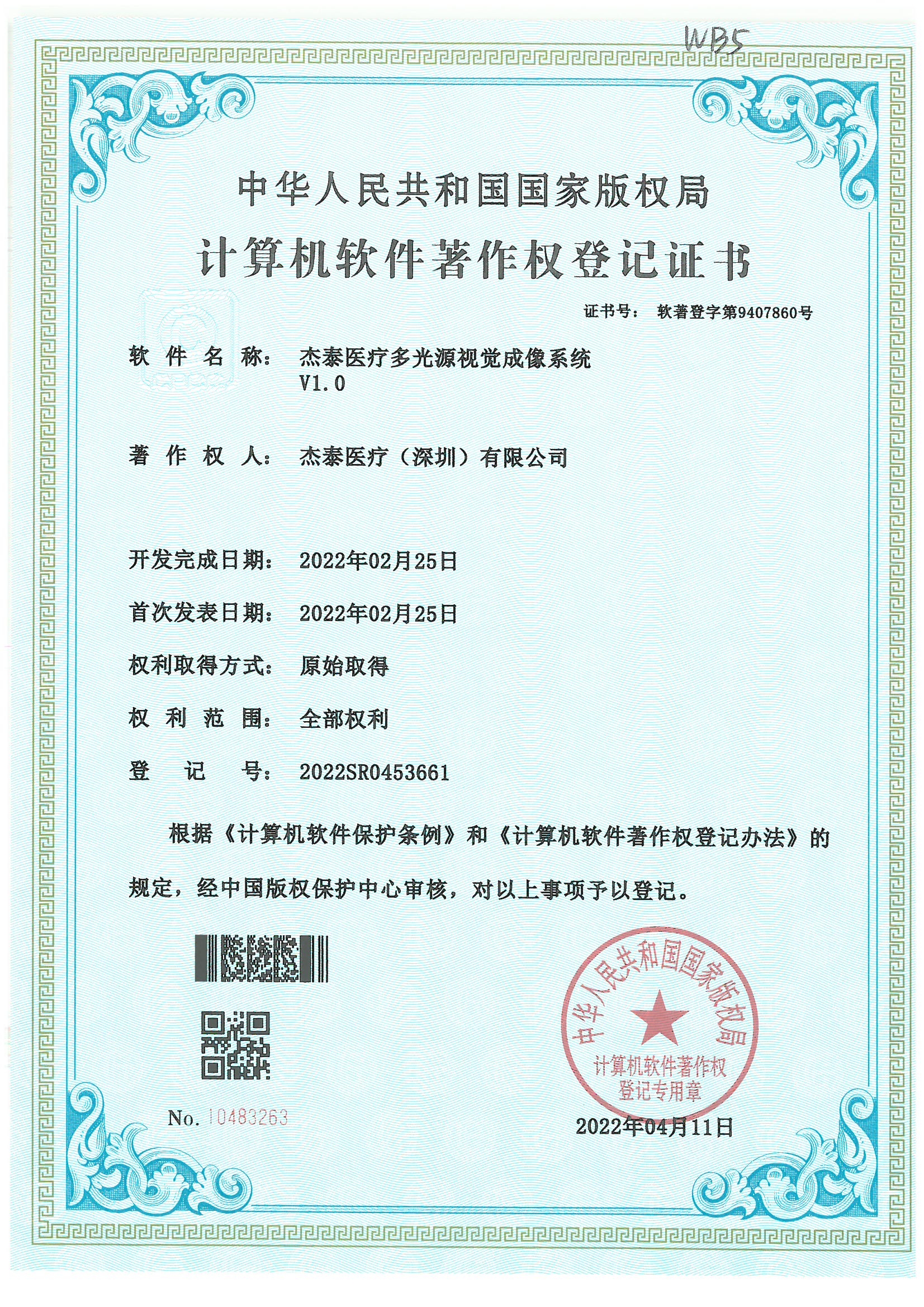
CCPD software copyright registration certificate for the Jeet Medical Multi-Light Source Vision Imaging System V1.0 (No. 9407860, issued 2022-02-25).
The Four Decision Factors in Practice
1. Patient size and route of insertion
Tube diameter follows the narrowest point the scope must pass, not the body weight of the animal. In small-animal practice with dogs and cats, ear and nasal examination is handled by the 3.1 mm RAE-201 tube or the 3.9 mm RAE-500 lens, while gastrointestinal examination in large animals is specified with 5.8 mm insertion tubes (RAE-109, VET-5820) or 8.5 mm (VET-8528). Where two configurations can both physically reach a target, the smaller diameter is the safer route choice and the larger channel is the one to reserve for procedures that need it.
2. Target anatomy and depth of field
Depth of field is the specification that is most often ignored and most often responsible for disappointing images. The otoscope configurations are specified at 5–50 mm (RAE-201) and 5–50 mm focal length (RAE-500), matching shallow ear and nasal targets. The GI configurations are specified at 7–100 mm, matching a target that sits further from the lens. Field angle moves in the other direction: 120° on the flexible otoscope and gastroscope configurations, 78° field of view on the RAE-500.
3. Imaging, display and documentation
Three imaging paths exist in this range: an integrated 1.85-inch screen with built-in 8 GB storage (RAE-500); USB connection to Android, Windows or iOS devices (RAE-105, RAE-105Pro, RAE-109); and USB plus WiFi (RAE-105Pro, RAE-107). Choose the integrated-screen path when examinations happen away from a desk or when the practice wants minimal setup; choose the USB or WiFi path when images and video need to reach practice software on a larger screen. Resolution across the range runs from 160,000 pixels (RAE-201) to 1,000,000 pixels (RAE-105, RAE-105Pro, RAE-107, RAE-109) and 1080P (VET-5820, VET-8528).
4. Mobility: clinic room, field or farm
Portability here is a design question, not a marketing one. All configurations described are portable, and image review no longer requires a cart. For farm and field work the deciding features are the connection type (WiFi or USB with a tablet or phone) and whether the configuration supports water and air supply with suction — features the RAE-107 lists as available alongside its forceps working channel.
5. Single-veterinarian operation
Steering geometry determines whether one pair of hands can manage the scope and the patient. The RAE-201 steers up and down with a 180° bending angle for ear and nasal examination. The RAE-109 combines 360° steering with 180° up/down and 180° left/right bending. The VET-5820 uses a 180° bending angle with 360° rotation control. The RAE-107 lists 360° directional control together with single-veterinarian operation as available. In practices with limited restraint support, steering range is the specification that decides whether a second pair of hands is required.
Step-by-Step: Selecting a Configuration in Six Steps
- Name the dominant exam type. If most of the caseload is ear and nasal work, buy the otoscope configuration first; GI endoscopy is a separate purchase with a separate specification set.
- Fix the working length from the deepest target. 600 mm for ear and nasal examination (RAE-201); 1,000 mm (RAE-107) or 1,500 mm (VET-5820, VET-8528) for gastrointestinal examination.
- Fix the outer diameter from the narrowest route. 3.1 mm (RAE-201) or a 3.9 mm lens (RAE-500) for ear and nasal work; 5.8 mm for standard GI insertion tubes; 8.5 mm where a larger channel is the priority.
- Decide what the channel must carry. 1.2 mm (RAE-201), 2.0 mm (RAE-109, VET-5820, RAE-107, RAE-105, RAE-105Pro) or 2.8 mm (VET-8528). The channel is what allows flushing, suction or forceps work during the same procedure.
- Choose the imaging and connection path. Integrated screen with built-in storage (RAE-500) versus USB or WiFi to Android, Windows or iOS (RAE-105, RAE-105Pro, RAE-107, RAE-109).
- Confirm commercial and acceptance terms. Minimum order quantity is 1 unit, delivery terms are FOB and CIF, payment terms are T/T in advance, and acceptance criteria are 100% pre-shipment inspection and functional test. Confirm the production schedule for the exact configuration rather than for a generic model name.
Step six is where purchases lose time. Because the acceptance criteria are 100% pre-shipment inspection and functional test, and payment terms are T/T in advance, the configuration list — including channel accessories and, where the model supports them, water and air supply with suction — should be finalised before a schedule is agreed.
Use Cases: Four Practice Profiles
Profile 1 — Solo small-animal clinic with an ear-heavy caseload
The RAE-500 is the natural first purchase: a 1.85-inch integrated screen, 720 × 720 pixel image and video resolution, 6 LED lights, 1x/1.2x/1.5x magnification and 8 GB of built-in storage allow ear examinations to be captured and stored without additional hardware. If the caseload also requires channel-based procedures such as flushing or sampling, the RAE-201 adds a 1.2 mm working channel on a 3.1 mm tube with a 600 mm working length.
Profile 2 — Small-animal practice building a GI service
The RAE-109 is the entry configuration for gastrointestinal work: a 5.8 mm outer diameter, 2.0 mm working channel, 1,000,000 pixels, 360° steering and USB connection to Android, Windows or iOS hardware. It uses equipment the practice already owns as the display and capture device, and its 7–100 mm depth of field matches a target that sits further from the lens than in otoscopy.
Profile 3 — Mobile practice and large-animal field work
Field work changes the priority order: connection type and depth reach come first. The RAE-107 offers a 1,000 mm working length, WiFi connection, 360° directional control, water and air supply with suction, forceps working channel and single-veterinarian operation. For full-depth gastrointestinal examination in large animals, the VET-5820 provides a 1,500 mm working length with 1080P imaging and a 120° field angle, while the VET-8528 adds an 8.5 mm tube and a 2.8 mm channel when larger instruments must pass.
Profile 4 — Distributors, teaching hospitals and multi-site groups
Buyers who supply clinics rarely sell one configuration. A distributor fleet typically combines an ear/nasal platform (RAE-201, RAE-500) with a GI platform (RAE-109, VET-5820, VET-8528) so that each clinical scenario is covered without over-specifying a single unit. JeetVet reports deployments through distributor clients, with projects implemented in Russia and Ukraine, which is relevant when regional support and service questions arise during evaluation. Commercial terms support this model: minimum order quantity of 1 unit, FOB and CIF delivery terms, T/T in advance, and 100% pre-shipment inspection and functional test as acceptance criteria.

Jeet Medical production facility — company-provided image from the manufacturer of JeetVet veterinary endoscopes.
Comparison Table: Ear/Nasal vs GI Configurations
The tables below use published JeetVet specifications only. A dash means the parameter is not stated in the published specification for that model.
Table 1 — Ear and nasal configurations
| Specification | RAE-201 (Veterinary Flexible Otoscope) | RAE-500 (Portable Smart Veterinary Otoscope) |
|---|---|---|
| Product type | Veterinary Flexible Otoscope — animal ear and nasal examination | Portable Smart Veterinary Otoscope |
| Working length | 600 mm | — |
| Outer tube / lens diameter | 3.1 mm tube | 3.9 mm lens |
| Working channel | 1.2 mm | — |
| Depth of field / focal length | 5–50 mm | 5–50 mm focal length |
| Field angle / field of view | 120° | 78° |
| Image resolution | 160,000 pixels | 720 × 720 pixels |
| Display | — | 1.85-inch integrated screen |
| Connection | — | Type-C |
| Magnification / lighting / storage | — | 1x, 1.2x, 1.5x; 6 LED lights; 8 GB built-in |
Table 2 — Gastrointestinal configurations
| Specification | RAE-109 | VET-5820 | VET-8528 | RAE-107 |
|---|---|---|---|---|
| Product type | Portable USB Veterinary Gastroscope | Portable Veterinary Gastroscope for Large Animals | Portable Veterinary Endoscope for Large Animals | Portable WiFi Veterinary Endoscope |
| Working length | — | 1,500 mm | 1,500 mm | 1,000 mm |
| Outer diameter | 5.8 mm | 5.8 mm | 8.5 mm | 5.8 mm |
| Working channel | 2.0 mm | 2.0 mm | 2.8 mm | 2.0 mm |
| Bending / rotation | 360° steering; 180° up/down and 180° left/right | 180° bending; 360° rotation control | 180° bending; 360° rotation control | 360° directional control |
| Field angle | 120° | 120° | 120° | — |
| Depth of field | 7–100 mm | 7–100 mm | 7–100 mm | 7–100 mm |
| Image resolution | 1,000,000 pixels | 1080P | 1080P | HD; 1,000,000 pixels |
| Connection | USB | — | — | WiFi |
| Water/air supply, suction, forceps channel, single-vet operation | — | — | — | Available |
Source: published JeetVet / Jeet Medical product specifications. Compatible systems on the RAE-109 and RAE-105 are Android, Windows and iOS.
FAQ: Veterinary Endoscope Selection Questions
Do JeetVet veterinary endoscopes for ear and GI examination meet recognized quality and standards requirements?
Jeet Medical’s quality management system is certified to ISO 13485 by SGS, and manufacturing takes place in a 100,000-class cleanroom with a 10,000-class microbiological laboratory. At product level, the ISO 8600 series is the international standard family for medical endoscope optics: ISO 8600-1 covers general requirements and ISO 8600-3 addresses field of view, which is why field angle should appear on any veterinary endoscope datasheet you compare. Jeet Medical also holds CCPD software copyright registration certificates for the imaging platforms referenced across this product family: the Jeet Medical Multi-Camera Automatic Fusion System V1.0 (certificate No. 9413508, issued 2022-03-10) and the Jeet Medical Multi-Light Source Vision Imaging System V1.0 (certificate No. 9407860, issued 2022-02-25). The certificate for the Multi-Camera Automatic Fusion System V1.0 is issued by CCPD.
Can a single veterinarian operate both the ear/nasal and GI configurations?
Yes, with the right model per scenario, because the control schemes are built for one-operator use. The RAE-201 uses up-and-down steering with a 180° bending angle for ear and nasal examination. The RAE-109 combines 360° steering with 180° up/down and 180° left/right bending, and the VET-5820 adds 360° rotation control for gastrointestinal work. Where a clinic wants one unit covering channel-based procedures and mobility, the RAE-107 lists a forceps working channel, water and air supply with suction, WiFi connection and single-veterinarian operation as available, with a 1,000 mm working length and a 2.0 mm channel. Ear examinations still call for the smaller 3.1 mm tube of the RAE-201 or the 3.9 mm lens of the RAE-500, because tube diameter is the limiting factor in narrow anatomy.
What drives the cost of a veterinary endoscope configuration, and how can a small clinic control it?
Price differences between configurations track specifications rather than brand labels alone. The parameters that change across the models on this page are working length (600 mm on the RAE-201 versus 1,500 mm on the VET-5820), outer tube diameter (3.1 mm to 8.5 mm), working channel (1.2 mm to 2.8 mm), imaging resolution (160,000 pixels to 1080P), and the display and connection path — an integrated 1.85-inch screen on the RAE-500 versus USB or WiFi connection to Android, Windows or iOS on the RAE-105, RAE-105Pro, RAE-107 and RAE-109. Purchasing terms allow a staged approach: the minimum order quantity is 1 unit, delivery terms are FOB and CIF, and payment terms are T/T in advance, so a small clinic can start with the single configuration matching its main caseload and add a second platform later.
Can we validate a unit before committing to a larger order?
Yes. The minimum order quantity is 1 unit, and every unit is subject to 100% pre-shipment inspection and functional test before it leaves the factory — these are the stated acceptance criteria. Validation matters most for scenario fit: an ear-and-nasal configuration should be checked on the cases you handle most often, for example confirming that the RAE-201’s 5–50 mm depth of field and 1.2 mm channel do what you need at the working distance you actually use, and that the RAE-500’s 720 × 720 resolution, 6 LED lights and 1x/1.2x/1.5x magnification produce documentation images you can store and review.
What are the delivery terms and lead time considerations when ordering?
Delivery terms are FOB and CIF, and payment terms are T/T in advance; production lead time should be confirmed for the specific model and quantity you order, because working length, channel size and connection type can all affect what is built. Before finalising a shipping schedule, align three items: the acceptance criteria (100% pre-shipment inspection and functional test), the configuration list per exam type, and the accessories or spares you want in the same shipment. Regional support questions are worth raising in the same conversation, since JeetVet reports deployments through distributor clients with projects implemented in Russia and Ukraine. To move forward, request a configuration quote or a single-unit sample through jeetvet.com, download the product brochure, or contact troy@jeetmed.com / +86 755-23251842.
Conclusion: Matching Configuration to Clinic Type
The decision rule is simple once the exam type is fixed. Ear and nasal examination is a small-diameter, short-depth-of-field problem, answered by the RAE-201 (600 mm working length, 3.1 mm tube, 1.2 mm channel, 5–50 mm depth of field) or the RAE-500 (self-contained otoscope with a 1.85-inch screen, 3.9 mm lens, 5–50 mm focal length and 8 GB storage). Gastrointestinal examination is a reach-and-channel problem, answered by the RAE-109 (5.8 mm, 2.0 mm channel, 1,000,000 pixels, USB), the VET-5820 (1,500 mm working length, 1080P), the VET-8528 (8.5 mm tube, 2.8 mm channel) or the RAE-107 (1,000 mm, WiFi, water and air supply with suction, single-veterinarian operation). The selection matrix below applies that logic by clinic type.
| Clinic / buyer profile | Primary exam focus | Recommended configuration | Specification basis |
|---|---|---|---|
| Solo small-animal clinic, ear-heavy caseload | Ear and nasal examination | RAE-500 | 3.9 mm lens, 5–50 mm focal length, 1.85-inch integrated screen, 6 LED lights, 8 GB storage — no external monitor needed |
| Small-animal clinic needing flushing, sampling or fine instrumentation in ear/nasal work | Ear and nasal examination with channel access | RAE-201 | 600 mm working length, 3.1 mm tube, 1.2 mm channel, 5–50 mm depth of field, 120° field angle, 180° bending |
| Small-animal practice starting a GI service | Gastrointestinal examination | RAE-109 | 5.8 mm outer diameter, 2.0 mm channel, 1,000,000 pixels, 360° steering, 7–100 mm depth of field, USB to Android/Windows/iOS |
| Mixed or mobile practice, farm and field visits | GI examination and field diagnostics | RAE-107 | 1,000 mm working length, WiFi, 360° directional control, water and air supply with suction, forceps channel, single-veterinarian operation |
| Equine or large-animal practice | Gastrointestinal examination in large animals | VET-5820 | 1,500 mm working length, 5.8 mm tube, 2.0 mm channel, 1080P, 120° field angle, 360° rotation control |
| Large-animal hospital needing a larger instrument channel | GI examination with larger instruments | VET-8528 | 1,500 mm working length, 8.5 mm tube, 2.8 mm channel, 1080P imaging |
| Distributor, group purchasing or teaching hospital | Multiple exam types across sites | Mixed fleet: RAE-201 or RAE-500 plus RAE-109 or VET-5820 | MOQ 1 unit, FOB and CIF delivery terms, T/T in advance, 100% pre-shipment inspection and functional test |
Selection matrix based on published JeetVet / Jeet Medical specifications and stated purchasing terms. Match final configuration to the anatomy and case mix of your own practice.

JeetVet veterinary endoscope production — portable otoscope and gastroscope configurations for ear/nasal and GI examination.
Next step: request a configuration quote, a single-unit sample (MOQ 1 unit) or the current product catalogue for the ear/nasal and GI platforms covered in this guide.
Download the JeetVet product brochure (PDF)
Jeet Medical (Shenzhen) Co., Ltd. — Email: troy@jeetmed.com | Tel: +86 755-23251842 / +86 13381945549 | WhatsApp: +86 13816158380 | Address: 9th Floor, Block B, Building 1, No. 76 Baohe Avenue, Longgang District, Shenzhen, China | Web: www.jeetvet.com | Blog: blog.jeetvet.com
Have Questions or Need More Details?
Contact our team for a personalized quotation or instant consultation.
Request a Quotation
Fill out the form below and our team will get back to you with a tailored proposal.
WhatsApp Direct Chat
Prefer to chat in real-time? Message us on WhatsApp for instant assistance & quick answers.
- Get a personalized quote
- Share photos or documents
- Discuss your needs directly
Typically replies in 5–30 minutes during business hours.