
Veterinary Endoscope Supplier Evaluation for Distributors

A distributor that signs a veterinary endoscope supply agreement buys hardware once and clinical credibility repeatedly. The distributor promises a clinical range first — canine and feline upper GI, large-animal gastrointestinal work, ear and nasal examination — and must then supply instruments that match that range and stay consistent across every clinic on the contract.
Most supplier evaluations fail because they never leave the meeting room. A deck, a catalogue and a quotation produce an impression, but nothing in that package converts a promise into something testable. The seven-step process below turns each supplier statement into one of three things: a documented specification, a contractual clause, or a demonstration the distributor can watch and record.
Define the risk before you compare suppliers
Distributor risk runs along three lines, and they rarely break in the same place.
The first is anatomy and working channel. Every dimension on a veterinary endoscope is measured in millimetres, and a fraction of a millimetre decides which cases a clinic can accept. The RAE-201 is a veterinary flexible otoscope with a 3.1 mm outer tube diameter, a 1.2 mm working channel and a 600 mm working length — a combination built for ear and nasal examination, including flushing and biopsy access in smaller patients. It is not a substitute for a scope with a 2.8 mm channel in a large-animal gastrointestinal study, and a distributor who sells it as one has created a complaint before the first invoice clears.
The second is imaging and control. Image resolution, field angle, depth of field and bending behaviour are what the veterinarian actually works with. A scope that reaches the target but returns an image the clinician cannot interpret has still failed the case.
The third is commercial continuity. A distributor who selects the wrong model misjudges once and corrects it. A distributor who signs without an acceptance procedure, a spare-parts list and a change-notification window repeats the same exposure on every order for the life of the agreement. That second failure is the expensive one, and it is the one this evaluation process exists to prevent.
What distributors are actually buying now
The veterinary endoscope category has split into two parallel architectures. Modular tower systems pair a reusable camera with separate rigid or flexible scopes; portable systems build the imaging chain into the handle and connect to a phone, tablet or computer. Mordor Intelligence estimates the global veterinary endoscopy market at USD 332.95 million in 2026, with a projected CAGR of 7.35% from 2026 to 2031. That figure is a commercial research estimate rather than a customs or government statistic, but it is enough to explain why distributor programmes are now negotiated rather than simply ordered.
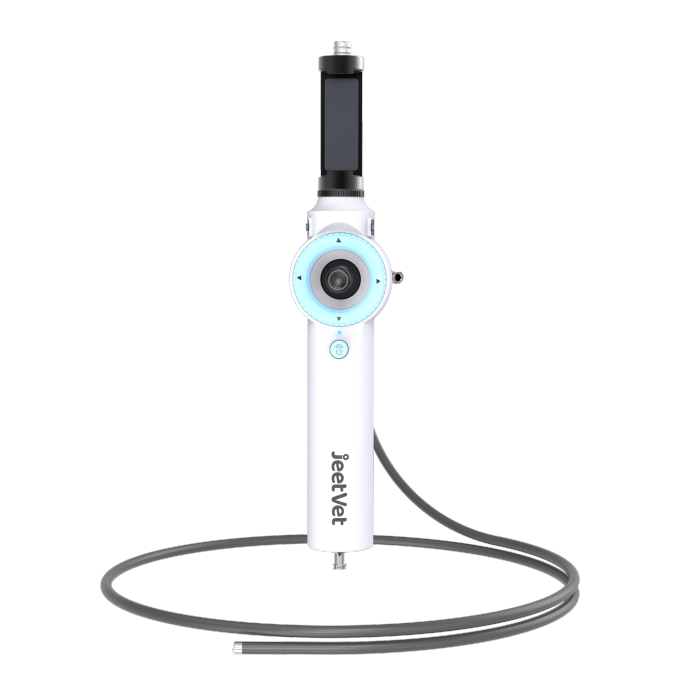
Portable systems changed the inventory model. configurations such as the RAE-105, RAE-105Pro and RAE-109 are listed at under 1 kg with a 5.8 mm outer diameter, which means they can be stocked per clinic rather than per platform. A supplier whose catalogue spans both 5.8 mm and 8.5 mm outer diameters lets a distributor build a small-animal line and a large-animal line from one relationship instead of two — a structural advantage that shows up in freight, training and spare-parts complexity long before it shows up in unit price.
Customs classification deserves a line of its own. According to the TariffNumber entry for 90189020, veterinary endoscopes move under HS code 90189020, the heading covering endoscopes used in medical, surgical or veterinary sciences. The code does not separate veterinary instruments from human ones, so the commercial invoice usually needs a plain-language description that matches the goods. Get that wrong and the delay lands on the clinic, not on the supplier.
The seven-step supplier evaluation
Step 1 — Write the clinical range before you write a model number
Build the scope of supply as a grid: animal type on one axis, procedure on the other. Small-animal upper GI, small-animal airway, ear and nasal examination, large-animal gastrointestinal work and equine field calls each carry different diameter, length and channel requirements. Every cell the distributor intends to serve must be filled in before a supplier meeting, because a supplier will always sell into the space the buyer leaves open.
Add the operating envelope to the same document. The published working condition for these instruments is an operating temperature of 0 °C to 40 °C, a storage temperature of −10 °C to 55 °C and relative humidity up to 80% non-condensing, with intended use in veterinary clinics, animal hospitals and field environments, including mobile veterinary services. A scope that travels in a van is stored and handled differently from one fixed to a tower, and the buyer should confirm the clinic will store it within those limits.
Step 2 — Attach every requirement to a published data sheet
This is where most evaluations quietly lose their value. A specification that cannot be tied to a model number and a data sheet is a preference, not a requirement.
Take the RAE-107 as a worked example. It is a portable WiFi veterinary endoscope listed with a 1000 mm working length, 5.8 mm outer diameter, 2.0 mm working channel, 1,000,000 pixels, 360° directional control, 7 mm to 100 mm depth of field, WiFi connection, water and air supply, suction, a forceps working channel and single-veterinarian operation. Each of those points is checkable. Each one can be written into an order as a pass-or-fail item.
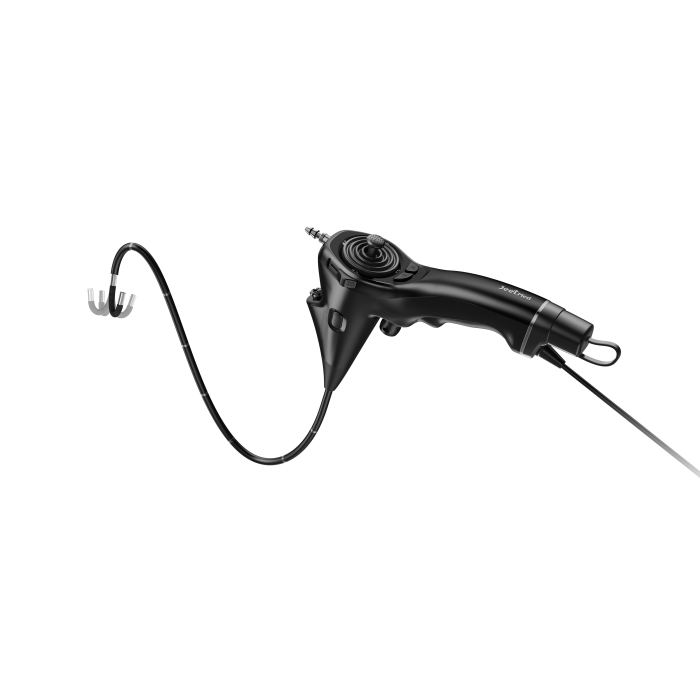
Now take a large-animal configuration. The VET-8528 is a portable veterinary endoscope for large animals listed with a 1500 mm working length, 8.5 mm outer tube diameter, 2.8 mm working channel, 1080P pixels, a 120° field angle, 7 mm to 100 mm depth of field, 180° bending angle and 360° rotation control, in a high-definition format intended for gastrointestinal examination.
Put the two side by side and the evaluation writes itself: same supplier, different working length, different channel, different outer diameter and different clinical job. A distributor who asks for “a veterinary endoscope” gets whichever of these is on the shelf.
Step 3 — Convert specifications into signable acceptance criteria
Acceptance criteria are the point where a catalogue becomes a contract. Three traps catch distributors here.
The first trap is borrowing one product line's numbers for another. The RAE-500 portable smart veterinary otoscope is listed with a 78° field of view, a 3.9 mm lens diameter, a 5 mm to 50 mm focal length, 1x, 1.2x and 1.5x image magnification, six LED lights, a 1.85-inch screen, 720 × 720 pixel image and video resolution and 8 GB of built-in memory. If the purchase order says “120° field angle” because that is the number on the flexible scopes, the otoscope fails an acceptance test it was never designed against. Write the criterion per product line, not per brand.
The second trap is ignoring depth-of-field differences. Flexible scopes in this range are listed at 7 mm to 100 mm; the RAE-201 flexible otoscope is listed at 5 mm to 50 mm, and the RAE-500 at 5 mm to 50 mm focal length. A depth-of-field clause copied across lines produces either a rejected unit or, worse, a waived clause that nobody notices until the first difficult case.
The third trap is ambiguity in bending and rotation. The VET-5820 and VET-8528 list a 180° bending angle with 360° rotation control. The RAE-105, RAE-105Pro and RAE-109 list a 180° up-and-down bend combined with a 180° left-and-right bend, plus 360° steering. Those are not the same statement, and they should not share one acceptance line.
A workable acceptance line for a flexible scope: the delivered unit matches the data sheet on outer diameter, working length, working channel, pixel count, field angle, depth of field and bending angle; it articulates through its full stated range on the bench; it passes a suction and channel-access check with the accessory the distributor intends to stock; and the serial number is recorded against the receiving document.
Step 4 — Verify the manufacturing and quality system, not the brochure claim
Quality claims are where distributors most often accept a sentence in place of a document. Jeet Medical (Shenzhen) Co., Ltd. is a manufacturer specialising in the research, development, design and manufacturing of veterinary endoscopes and devices, established in 2020 and operating from a 5000 m² manufacturing facility, with approximately 130 employees and a 30-engineer R&D team. The company states that it is certified under ISO 13485 by SGS, and that it operates a 100,000-class cleanroom and a 10,000-class microbiological laboratory.
The distributor's job is not to doubt that; it is to close it. Request the certificate, the issuing body, the certificate number and the scope, and confirm the scope covers the product family being purchased. Ask which site the certificate applies to. Ask whether the cleanroom class quoted applies to the production line that will build the order. A certificate with the wrong scope is worse than no certificate, because it will pass an internal review and fail an importer's audit.
Software is part of the same review. The Jeet Medical Multi-Camera Automatic Fusion System V1.0 holds a Computer Software Copyright Registration Certificate (No. 9413508) issued by CCPD for the CN market. If the distributor's configuration depends on that software, the version, the supported operating systems and the update path belong in the technical file — not only in the sales conversation.
For the underlying product portfolio, a distributor can verify the range directly: portable veterinary endoscopes, veterinary otoscopes, veterinary flexible otoscopes and veterinary gastroscopes. That breadth matters because it lets a single evaluation cover several clinical categories, but only if each category is checked on its own terms.
Step 5 — Turn delivery assurance into clauses, not assurances
No supplier voluntarily writes its weakest commitment into a quotation, and a distributor who relies on a verbal delivery promise has no remedy when the clinic's opening date is missed. Delivery assurance has to be built from five written items:
- Quotation anatomy. Unit, accessories, consumables, training, freight and packaging must be priced separately so two suppliers can be compared line by line rather than on a single bottom number.
- Acceptance procedure. Who inspects, against which checklist, within how many days of arrival, and what happens to a unit that fails.
- Change notification. A defined notice period for any change to a specification, component or firmware version that would affect a signed acceptance criterion.
- Traceability. Serial-number or batch-level records that let the distributor tie a delivered unit back to an inspection record.
- Non-conformity route. The named contact, the evidence required and the expected disposition for a rejected unit, agreed before the first shipment.
These are questions to put to any supplier, including JeetVet. The point is not that one supplier will answer better than another; it is that a distributor who asks has a written answer, and a distributor who does not has a recollection.
Step 6 — Fix the after-sales obligation in writing
The instrument is reusable after sterilisation and rated for continuous working in clinical use, which means the service relationship outlasts the warranty conversation. Ask for the spare-parts catalogue and the parts that carry the highest replacement frequency. Ask how a repair is routed, whether units travel to the manufacturer or to a regional partner, and who pays freight in each direction. Ask what documentation accompanies a repaired unit.
Where a distributor will place units in multiple clinics, the same questions should be answered at the programme level: one escalation contact, one return address, one reporting format. A distributor managing fifteen clinics cannot run fifteen different return processes.
Step 7 — Run a pilot batch and close the loop before the long-term agreement
A pilot is not a formality. It should cover every clinical category the distributor has promised, at least once, using the accessories that will actually ship. Record four things for each unit: the model and serial number, the data-sheet parameters checked on arrival, the procedure the pilot clinic used it for, and any deviation from the acceptance criteria.
Sign the long-term agreement only when the pilot documentation matches the written specification and the delivery terms have been tested at least once against a real order date. A supplier that performs on a small order under observation is not proven, but a supplier that misses on a small order under observation has already told the distributor what a large one will look like.
Published specifications for distributor comparison
The table below uses only figures published in the product data for the JeetVet range. It is a comparison of documented parameters, not a ranking of clinical performance — no independent imaging or durability testing is asserted here.
| Model | Type | Outer diameter / working length | Working channel | Field angle & articulation | Imaging |
|---|---|---|---|---|---|
| RAE-201 | Veterinary flexible otoscope | 3.1 mm / 600 mm | 1.2 mm | 120°; 180° up & down | 160,000 pixels; 5–50 mm depth of field |
| RAE-500 | Portable smart veterinary otoscope | 3.9 mm lens; 5–50 mm focal length | Not listed | 78° | 720 × 720 pixels; 1.85-inch screen; 8 GB |
| RAE-105 | Portable USB veterinary endoscope | 5.8 mm; under 1 kg | 2.0 mm | 120°; 180° up & down and 180° left & right; 360° steering | 1,000,000 pixels; 7–100 mm depth of field |
| RAE-105Pro | Portable USB / WiFi veterinary endoscope | 5.8 mm; under 1 kg | 2.0 mm | 120°; 180° up & down and 180° left & right; 360° steering | 1,000,000 pixels; 7–100 mm depth of field |
| RAE-109 | Portable USB veterinary gastroscope | 5.8 mm; under 1 kg | 2.0 mm | 120°; 180° up & down and 180° left & right; 360° steering | 1,000,000 pixels; 7–100 mm depth of field |
| RAE-107 | Portable WiFi veterinary endoscope | 5.8 mm / 1000 mm | 2.0 mm | 360° directional control; field angle not listed | 1,000,000 pixels; 7–100 mm depth of field |
| VET-5820 | Portable veterinary gastroscope for large animals | 5.8 mm / 1500 mm | 2.0 mm | 120°; 180° bending; 360° rotation | 1080P; 7–100 mm depth of field |
| VET-8528 | Portable veterinary endoscope for large animals | 8.5 mm / 1500 mm | 2.8 mm | 120°; 180° bending; 360° rotation | 1080P; 7–100 mm depth of field |
Two rows carry the most procurement weight for a distributor. VET-5820 and VET-8528 share the same 1500 mm working length and the same 120° field angle but differ in outer diameter and channel — 5.8 mm with 2.0 mm, against 8.5 mm with 2.8 mm. That is not a small-animal versus large-animal split so much as a reach-versus-instrumentation split inside the large-animal range, and the distributor should decide which one anchors the programme and which one is the add-on.
Matching the range to the clinical promise
Three distributor configurations recur in this category, and the specification logic differs in each.
Small-animal clinic programme. The 5.8 mm family — RAE-105, RAE-105Pro, RAE-109 and RAE-107 — carries a 2.0 mm working channel and a 7 mm to 100 mm depth of field, which is the configuration that fits routine canine and feline gastrointestinal work. The choice between USB-only and USB/WiFi models is a clinic infrastructure question, not a clinical one: RAE-105 is listed with USB connection, while RAE-105Pro is listed with both USB and WiFi, and both are listed as compatible with Android, Windows and iOS systems.
Large-animal and equine field calls. The 1500 mm working length on VET-5820 and VET-8528 is what makes the large-animal configuration useful on a farm call rather than only in a hospital. The distributor's evaluation should test transport, storage within the stated −10 °C to 55 °C range, and handling from a vehicle, because these instruments are intended for field environments including mobile veterinary services.
Ear and nasal examination. RAE-201 and RAE-500 address a different job and should be evaluated against different criteria: channel access and working length for the flexible otoscope, focal length, magnification and screen behaviour for the smart otoscope. Application scope for this category includes flushing the ear canal and obtaining biopsies and cultures to identify the cause of nasal discharge or obstruction, which is why a distributor should confirm the accessory set before committing.
What this process cannot prove
An evaluation built on documented specifications is a control, not a guarantee, and three boundaries should be stated openly.
First, published parameters do not establish clinical superiority. The 2026 supplier and industry sources cited here do not contain independent image-quality, failure-rate or ergonomics testing for any veterinary endoscope brand, so a distributor should not represent one model as clinically better than another on the strength of a data sheet.
Second, public sources do not provide price, lead time or warranty terms for veterinary endoscope manufacturers. Any figure of that kind must come from a written quotation and a contract clause, not from a catalogue or an article.
Third, certification claims must be verified at certificate level and matched to the target market. A quality-system certificate establishes that a manufacturer operates a certified system; it does not by itself establish market access in a given jurisdiction, and the distributor remains responsible for confirming what the destination market requires.
Frequently asked questions
What evidence should exist before a veterinary endoscope supplier is approved for a distributor programme?
Three documents should exist before any commercial discussion closes: a quality-system certificate with the issuing body, certificate number and scope covering the product family being purchased; a documented manufacturing environment that supports the stated product claims; and a product data sheet for every model in the proposed range. Jeet Medical (Shenzhen) Co., Ltd., established in 2020, states that it is certified under ISO 13485 by SGS and operates a 100,000-class cleanroom and a 10,000-class microbiological laboratory — each of which a distributor should request in document form and reconcile against the models actually being ordered.
How does a distributor verify that published specifications match the product line?
By tying every parameter to one model number. The RAE-107 is listed with a 1000 mm working length, 5.8 mm outer diameter, 2.0 mm working channel and 360° directional control; the VET-8528 is listed with a 1500 mm working length, 8.5 mm outer diameter, 2.8 mm working channel, 1080P pixels, a 120° field angle, a 7 mm to 100 mm depth of field, 180° bending and 360° rotation. A specification that cannot be attached to a single model and a single data sheet should not enter the agreement.
How should a distributor structure quotation comparison to avoid cost surprises?
Compare itemised quotations, not totals. Separate the instrument, the accessories, consumables, training, freight, packaging and after-sales terms, and compare each line against the same clinical scope. Because public sources do not publish prices for veterinary endoscope manufacturers, the price basis has to come from the written quotation itself — and if a quotation hides items inside a single figure, the distributor should request the breakdown before signing rather than after the first repeat order.
Should a distributor test a sample before committing to a long-term agreement?
Yes, and the sample should cover every procedure in the promised range. A typical pilot set includes the RAE-201 flexible otoscope for ear and nasal work at 600 mm working length and 1.2 mm channel, a 5.8 mm small-animal model such as RAE-107 with a 1000 mm working length and 2.0 mm channel, and, if large-animal work is in scope, the VET-8528 at 1500 mm working length and 2.8 mm channel. Pass criteria are that the delivered unit matches the data sheet parameter by parameter, articulates through its full stated range, and arrives with a traceable serial number and inspection record.
What delivery and supply-continuity questions should a distributor formalise?
Formalise five: the named delivery commitment and the remedy if it is missed; the acceptance procedure with inspection window and rejection route; a notification period for specifications, components or firmware changes; the spare-parts list with the parts most likely to need replacement; and the service routing with freight responsibility in each direction. A distributor who has these in writing can answer a clinic's question about downtime without calling the factory — and if the next step is a sample, a quotation or a full catalogue review, the JeetVet team can be reached at troy@jeetmed.com or through www.jeetvet.com with the clinical scope and model list already attached.
Conclusion: sign on documents, not on impressions
A veterinary endoscope distributor programme is a specification problem wrapped in a supply-relationship problem. The seven steps above keep the two separate: define the clinical range first, attach every requirement to a specific model and data sheet, convert the numbers into acceptance criteria written per product line, verify the manufacturing system at certificate level, and put delivery, spares and change notification into the contract before the first order.
The evaluation will not produce a ranking, and it should not pretend to. What it produces is a file — one that records which model serves which procedure, which figures were checked on arrival, and which clauses protect the clinics downstream. That file is what a distributor has when a clinic asks why a scope was chosen, and it is the only part of the buying decision that survives the first difficult case.

Next step for distributors. Review the full JeetVet product range and technical data before the supplier meeting, then request a sample or quotation against your written clinical scope.
Catalogue download: JeetVet veterinary endoscope catalogue (PDF)
Email: troy@jeetmed.com | Tel: +86 755-23251842 / +86 13381945549 | WhatsApp: 8613816158380 | WeChat: 13381945549
Jeet Medical (Shenzhen) Co., Ltd., 9th Floor, Block B, Building 1, No. 76 Baohe Avenue, Longgang District, Shenzhen, China — www.jeetvet.com
Have Questions or Need More Details?
Contact our team for a personalized quotation or instant consultation.
Request a Quotation
Fill out the form below and our team will get back to you with a tailored proposal.
WhatsApp Direct Chat
Prefer to chat in real-time? Message us on WhatsApp for instant assistance & quick answers.
- Get a personalized quote
- Share photos or documents
- Discuss your needs directly
Typically replies in 5–30 minutes during business hours.