
Nasal Exams in Small Animals: An Application Guide to the RAE-201 Veterinary Flexible Otoscope
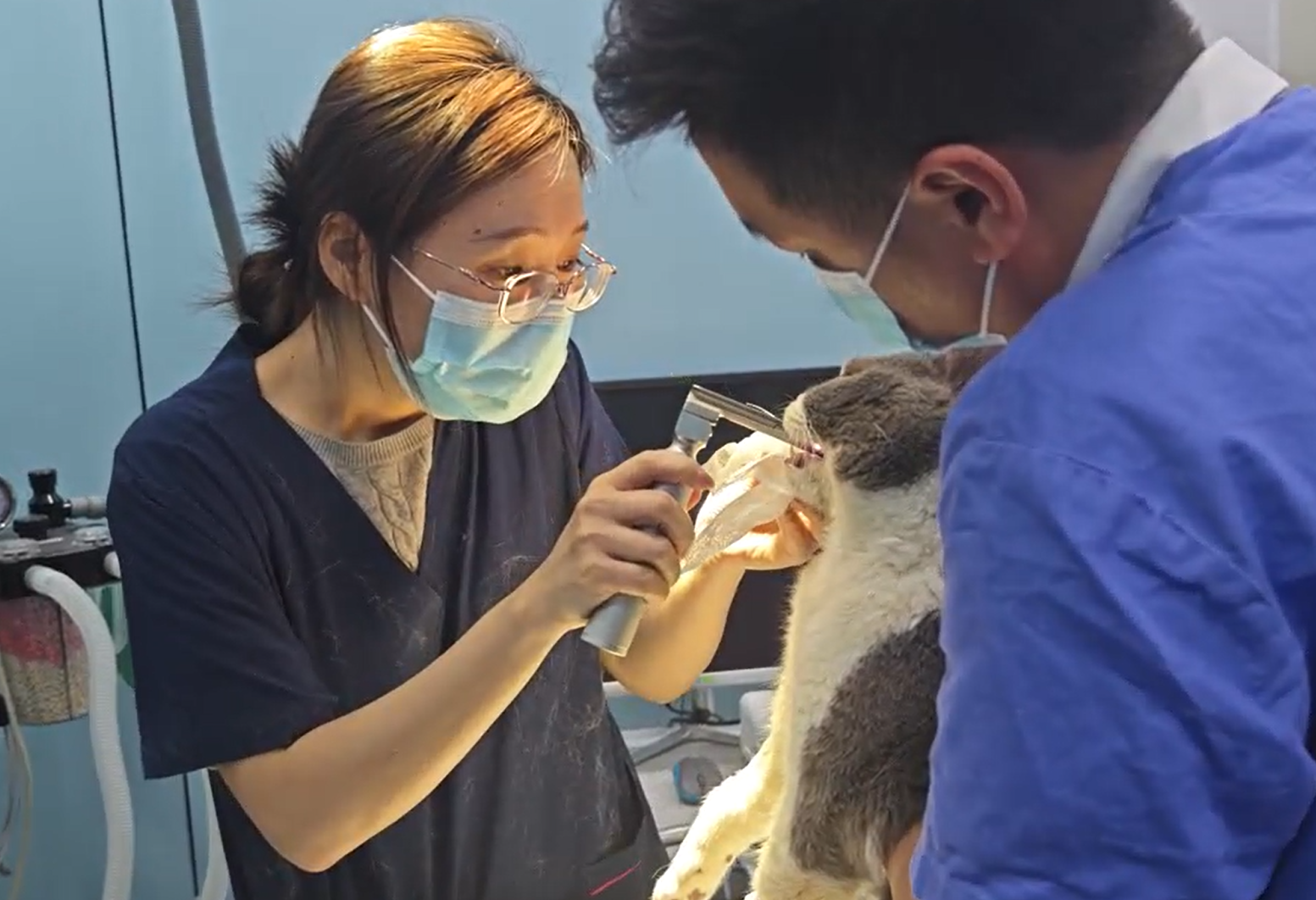
The RAE-201 Veterinary Flexible Otoscope is a JeetVet veterinary endoscope designed for animal ear and nasal examination. For a small-animal nasal exam, its most relevant documented specifications are a 600 mm working length, a 3.1 mm outer tube diameter, 180° up/down bending, a 120° field angle, a 5–50 mm depth of field, 160,000 pixels, and a 1.2 mm inner channel. These values define the device's access, articulation and viewing envelope. They do not replace patient assessment, training or clinic protocol.
This guide explains how to plan a nasal examination around those specifications. It covers patient positioning, gentle insertion, visualization, articulation, channel checks, use cases, and the RAE-201's role alongside the RAE-500 Portable Smart Veterinary Otoscope for clinic-based ear checks. JeetVet is the veterinary endoscope brand associated with Jeet Medical (Shenzhen) Co., Ltd., an ISO 13485 certified manufacturer.
What problem does the RAE-201 address in small-animal nasal exams?
A small-animal nasal examination asks the clinician to access a narrow, delicate passage, keep the patient stable, and see enough of the surface to decide what to do next. The practical constraints are access, illumination, image feedback, tip control and a repeatable workflow. A rigid instrument can be useful in some settings, but the RAE-201 is documented as a flexible otoscope for ear and nasal examination, with up/down steering and a 600 mm working length. Those features matter when the clinician needs to follow a curved passage rather than approach it in a straight line.
The device specification is not a clinical outcome claim. A 3.1 mm outer tube, a 1.2 mm inner channel and 160,000 pixels describe size, channel and image specification. They do not prove diagnostic accuracy, patient tolerance or superiority over another device. The buyer's question is narrower: does this documented configuration fit the intended nasal workflow, the patient size, the clinic's image-review needs and the procedures the team is trained to perform?
For a small animal, the 3.1 mm outer tube is a key check. The clinician should confirm that the insertion tube is appropriate for the individual patient and the planned procedure. The 600 mm working length provides reach along the flexible shaft, but reach is not the same as suitability. Patient anatomy, the need for sampling, restraint or anesthesia protocol, and the clinic's ability to maintain a clear view all remain part of the decision.
Industry background: why clinics are adding flexible nasal workflows
The veterinary endoscopy category is expanding. Mordor Intelligence estimates the global veterinary endoscopy market at USD 332.95 million in 2026 and projects a 7.35% CAGR from 2026 to 2031. The same source identifies North America as the largest market and Asia-Pacific as the fastest-growing region. These are category estimates, not evidence of any single model's market share or clinical performance.
Category growth does not mean every clinic needs the same device. It does mean that buyers are more likely to compare flexible otoscopes, portable endoscopes and clinic-based otoscope systems as part of the same equipment conversation. A small-animal practice may need a device that can support ear and nasal examination, while a mobile service may place more weight on operating conditions and transport. The documented operating range for the product platform is 0°C to 40°C, with storage at -10°C to 55°C and relative humidity ≤ 80% non-condensing. The application material describes use in veterinary clinics, animal hospitals, field environments and mobile veterinary services, indoors and outdoors.
Regulatory and trade checks sit alongside the clinical decision. In the United States, the FDA publishes information on how it regulates animal devices, and documentation expectations can differ by market. For cross-border procurement, the trade classification listed for endoscopes used in medical, surgical or veterinary sciences is HS 90189020. A distributor should confirm the destination market's requirements rather than assuming that one certificate or code covers every jurisdiction.
RAE-201 specifications that matter during a nasal examination
The RAE-201 product unit lists the following values. The right-hand column translates each value into a workflow question; it does not add a clinical claim.
| Documented specification | RAE-201 value | Workflow question |
|---|---|---|
| Purpose | Animal ear and nasal examination | Confirm the planned procedure is ear or nasal, not gastrointestinal or another application. |
| Working length | 600 mm | Check whether the reach matches the patient and procedure. |
| Outer tube diameter | 3.1 mm | Check patient size and access; do not assume universal fit. |
| Inner channel | 1.2 mm | Check accessory compatibility and sampling plan. |
| Bending angle | 180° | Plan for up/down tip control; do not assume 360° rotation. |
| Steering direction | Up and down | Confirm the clinician can navigate the intended passage with this motion. |
| Depth of field | 5 mm to 50 mm | Keep the target within the specified working distance. |
| Field angle | 120° | Check whether the field of view meets the clinic's image-review needs. |
| Pixels | 160,000 | Record the image specification; do not treat it as a diagnostic guarantee. |
| Material | Plastic, stainless steel, medical grade polymer, optical glass | Check reprocessing and handling instructions. |
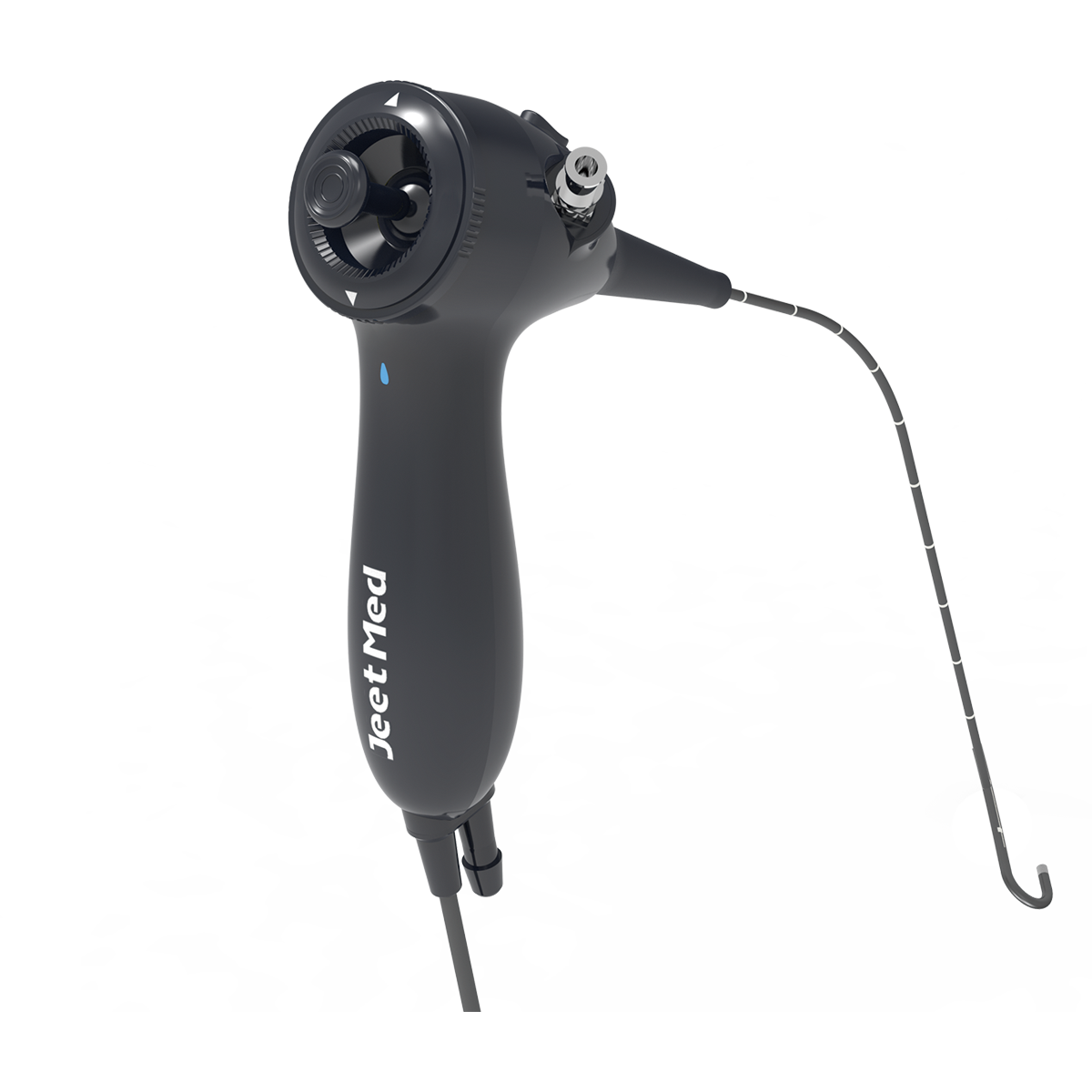
The 180° up/down bending angle is the steering specification, not a claim that the tip can pass every nasal geometry. The steering direction is up and down; this is different from a 360° rotation specification found on some other endoscope models. During a nasal exam, the value of up/down articulation is that the clinician can make controlled tip corrections while advancing, instead of relying only on shaft movement. The 120° field angle and 5–50 mm depth of field define the viewing envelope. The clinician still has to hold the tip at a useful distance and keep the lens clear.
The 1.2 mm inner channel is a separate specification from the outer tube. It matters when the procedure plan includes irrigation or sampling. The JeetVet application material for ear and nose endoscopy describes biopsies and cultures to identify the cause of nasal discharge or obstruction, and removal of foreign bodies or masses. It does not state that every accessory will pass the 1.2 mm channel. The clinician should match any instrument to the channel diameter and the manufacturer's instructions before use.
Step-by-step: using the RAE-201 for a small-animal nasal examination
This workflow is a planning framework for trained veterinarians. It is not a substitute for clinical training, local protocols or the manufacturer's instructions. The sequence below keeps the device specifications and the patient's safety in the same decision path.
1. Confirm the indication and the device configuration
Start with the clinical question. The RAE-201 is documented for animal ear and nasal examination. If the planned procedure is a nasal examination, confirm that the device, accessories and viewing setup are ready. Check the working length, outer tube diameter and channel specification against the case. A 3.1 mm outer tube may be appropriate for some small-animal nasal workflows and not for others; that is a clinical judgement, not a catalogue decision.
2. Prepare the environment and the equipment
The product platform is described for veterinary clinics, animal hospitals, field environments and mobile veterinary services, with indoor and outdoor use. The documented operating range is 0°C to 40°C, storage is -10°C to 55°C, and relative humidity should be ≤ 80% non-condensing. Confirm that the room or vehicle conditions are within that range. The application material also describes continuous working for clinical use and reuse after sterilization; follow the validated reprocessing instructions for the exact device and accessories.
3. Position the patient for a stable, accessible nasal approach
Position the patient so the nasal opening is accessible and the head and body are stable, using the clinic's standard restraint or anesthesia protocol. The goal is not a single universal position; it is a position that keeps the patient safe, the airway managed and the clinician's hands free for fine control. Support the patient's head so that small movements do not translate into large tip movements. Keep suction, lighting and any planned sampling instruments within reach before insertion begins.
4. Insert gently under direct visualization
Gentle insertion is a technique requirement, not a product claim. Advance only while viewing, keep the tip centred in the passage and stop if the view is lost or resistance increases. The 3.1 mm outer tube sets the physical envelope; the 600 mm working length gives the clinician more shaft to manage. A longer working length does not mean the tip should be advanced blindly. Use the image to guide each small movement, and keep the nasal passage in view rather than pushing against tissue.
5. Use the 180° up/down articulation for controlled navigation
The RAE-201's 180° bending angle and up/down steering direction allow controlled tip correction. Make small changes and re-check the view after each change. The purpose is to follow the nasal passage without forcing the shaft. Because the steering is up/down rather than 360° rotation, the clinician should plan the approach around that motion and use patient positioning and shaft rotation by hand where appropriate. Do not describe the device as a 360° rotation scope; that is a different specification.
6. Hold the target within the documented viewing envelope
The 120° field angle and 5–50 mm depth of field define the viewing envelope. In practice, the clinician adjusts the tip-to-target distance until the relevant surface is in view. The 160,000-pixel specification is the documented image value; it is not a guarantee of diagnostic quality. Image clarity also depends on illumination, lens cleanliness, secretions, motion and the display or processing chain used with the device. Keep the lens clear and reassess the view before making a clinical decision.
7. Check the 1.2 mm inner channel before sampling
If the plan includes irrigation, biopsy or culture, check the 1.2 mm inner channel against the accessory. The application material describes biopsies and cultures for nasal discharge or obstruction and removal of foreign bodies or masses, but the channel diameter is the limiting specification. Confirm that the selected instrument is compatible, that the sampling method is appropriate for the case, and that the sample will be handled correctly. If the required instrument does not fit, do not force it; choose another approach.
8. Document, reprocess and review the workflow
Record the examination conditions, the device configuration, the visible findings and any sampling performed. After the procedure, follow the manufacturer's reprocessing instructions for the device and accessories. Review whether the RAE-201's working length, 3.1 mm outer tube, 180° up/down control and 1.2 mm channel matched the case. That review is more useful than a generic impression of image quality, because it shows which specification helped or limited the workflow.
Use cases: where the RAE-201 fits in a small-animal practice
The primary documented use case is animal ear and nasal examination. Within that scope, the application material describes several practical tasks. The device can aid in the removal of foreign bodies or masses, and in flushing the ear canal. Biopsies and cultures can be obtained to identify the cause of nasal discharge or obstruction. These are application descriptions, not guarantees of a clinical result. The clinician remains responsible for case selection, technique and interpretation.
A second use case is workflow planning in a clinic that sees both ear and nasal cases. The RAE-201 gives the team a flexible otoscope with a documented 600 mm working length and up/down articulation, so the same device family can be considered for ear and nasal examination. The clinic should still check the 3.1 mm outer tube and 1.2 mm channel against each procedure, because ear and nasal anatomy impose different access and sampling requirements.
A third use case is field or mobile service. The product platform is described for indoor and outdoor use, including mobile veterinary services, with an operating range of 0°C to 40°C and storage at -10°C to 55°C. That does not mean every field environment is suitable. The clinician should protect the device from conditions outside the stated range, keep it clean and transport it according to the instructions. For distributors, the HS code 90189020 is a useful trade reference, but it does not replace market-specific regulatory checks.
RAE-201 and RAE-500: complementary otoscope roles
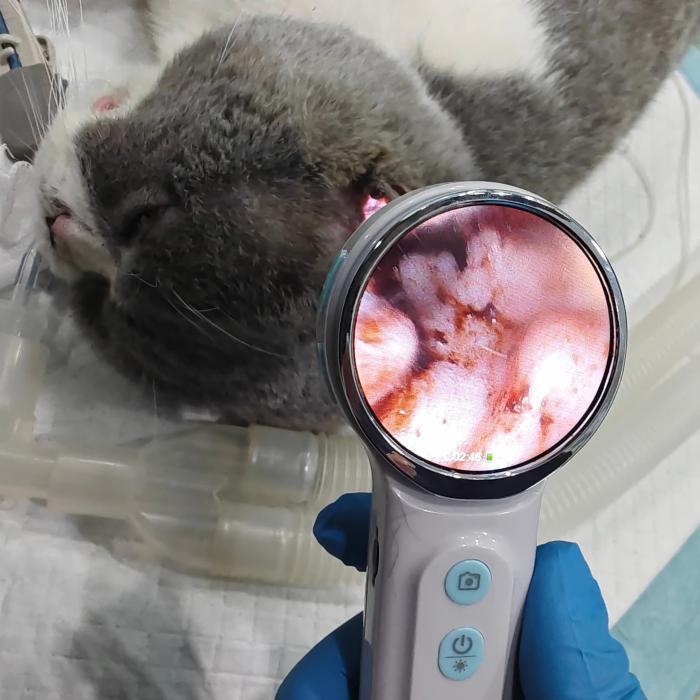
The RAE-500 Portable Smart Veterinary Otoscope is a separate product in the JeetVet portfolio. Its documented specification includes a 1.85-inch screen, 720 x 720 pixel image/video resolution, a 3.9 mm lens diameter, 5–50 mm focal length, a Type-C port, a 1 MP camera, 6 LED lights, 1x, 1.2x and 1.5x image magnification, a 78° field of view and built-in 8 GB memory. The RAE-201 is documented as a veterinary flexible otoscope for animal ear and nasal examination, with a 600 mm working length, 3.1 mm outer tube, 180° up/down bending, 120° field angle, 5–50 mm depth of field, 160,000 pixels and a 1.2 mm inner channel.
These are different documented configurations, so the choice is not a simple ranking. A clinic-based ear check may value the RAE-500's onboard 1.85-inch screen, 6 LED lights and 8 GB memory. A nasal examination workflow may need the RAE-201's longer working length, smaller outer tube and up/down articulation. The clinic can assign the RAE-201 to flexible ear and nasal examination and the RAE-500 to routine otoscope checks, provided the clinician confirms the device and accessories for each case. This is a workflow fit, not a claim that one device is clinically superior.
| Workflow question | RAE-201 | RAE-500 | Selection note |
|---|---|---|---|
| Documented role | Animal ear and nasal examination | Portable smart veterinary otoscope | Use the RAE-201 as the reference for the nasal workflow in this guide; use the RAE-500 for documented otoscope checks. |
| Access and control | 600 mm working length; 3.1 mm outer tube; 180° up/down bending; 1.2 mm inner channel | 3.9 mm lens diameter; 1.85-inch screen; Type-C port | Different form factors; compare only the attributes that matter to the planned procedure. |
| Viewing specification | 120° field angle; 5–50 mm depth of field; 160,000 pixels | 78° field of view; 5–50 mm focal length; 720 x 720 image/video; 1 MP camera | Match the viewing specification to the examination and image-review needs. |
| Practical workflow | Flexible otoscope for ear and nasal examination | Portable smart otoscope with onboard screen and 8 GB memory | A clinic can assign different roles to the two models rather than treating them as interchangeable. |
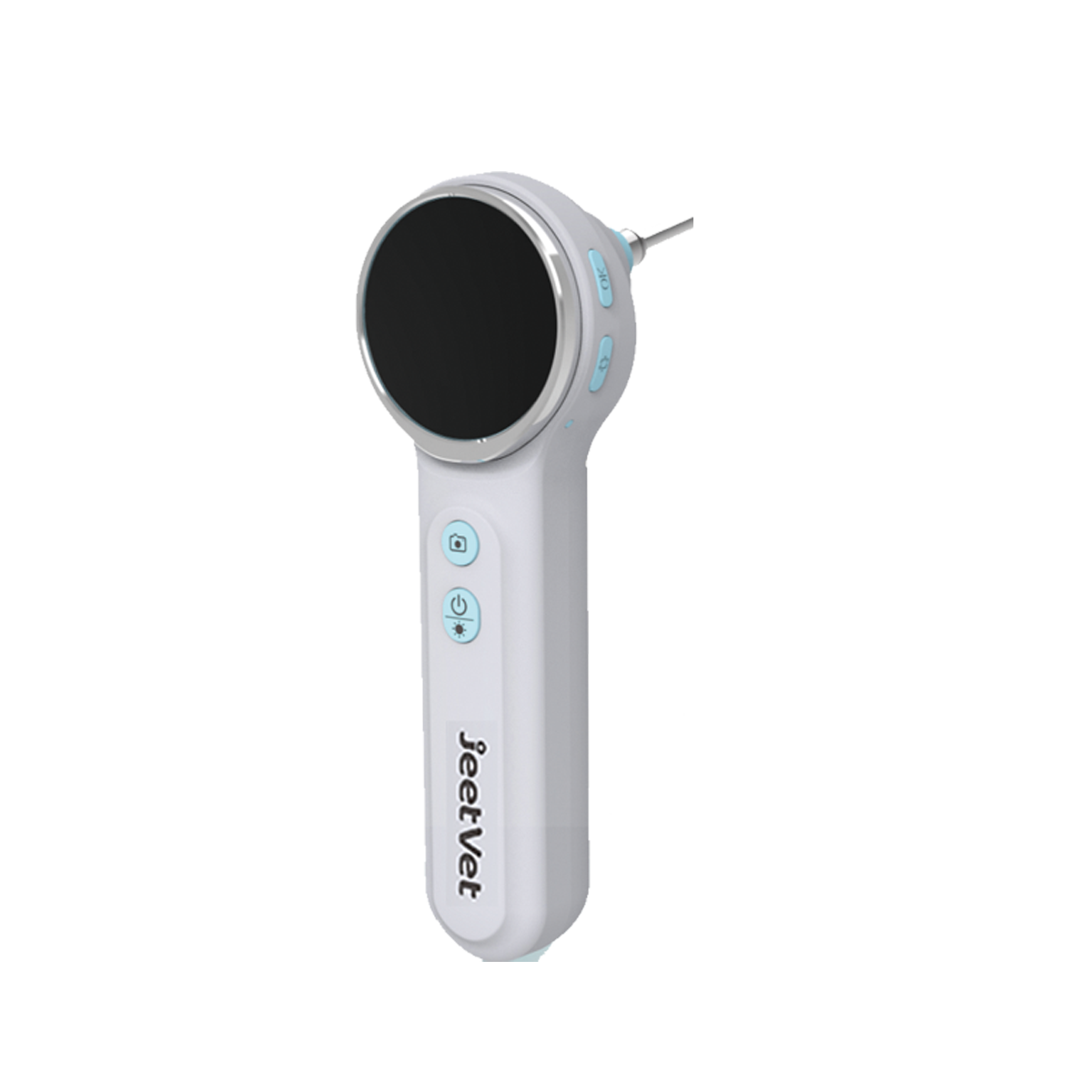
The comparison should also include a data check. The RAE-500 specification used for this guide does not list AI processing, so buyers who see the phrase AI veterinary otoscope should ask for a written functional description rather than treating the term as verified. The RAE-201 specification used here does not list a 360° rotation control; its bending angle is 180° up/down. These are documented differences, not defects. The relevant question is whether the documented function matches the procedure the clinic intends to perform.
Limitations and purchase checks before choosing the RAE-201
The RAE-201 is not a universal endoscope. Its documented purpose is animal ear and nasal examination. It should not be presented as a gastrointestinal, bronchoscopic or large-animal scope; those are different applications and, in the JeetVet portfolio, different models. The 3.1 mm outer tube and 1.2 mm inner channel are fixed specifications. They may be suitable for some small-animal nasal workflows and unsuitable for others. The 180° up/down bending angle gives controlled tip movement, but it is not a 360° rotation system. The 160,000-pixel image specification is a data point, not a promise of diagnostic image quality.
Before purchase, a clinic or distributor should ask for a written configuration list, the reprocessing instructions, the accessories available for the 1.2 mm channel, the warranty and service terms, and the current lead time for the exact configuration and destination. Price is not stated in the product unit used for this guide, so a quotation should be requested rather than inferred. For distributor evaluation, confirm the regulatory documents required in the destination market and the commercial terms in writing. The HS code 90189020 is a trade reference, not a market-access approval.
A practical evaluation should include a hands-on workflow check. Can the clinician position the patient, insert gently under visualization and hold the target within the 5–50 mm depth of field? Does the 180° up/down articulation help in the intended nasal passage? Is the 1.2 mm channel compatible with the planned sampling instruments? Does the image meet the clinic's review needs? These questions turn the specification sheet into a selection decision without inventing clinical performance claims.
FAQ: RAE-201 nasal examination questions
What is the RAE-201 Veterinary Flexible Otoscope designed to examine?
The documented purpose is animal ear and nasal examination. The product unit lists a 600 mm working length, 3.1 mm outer tube diameter, 1.2 mm inner channel, 180° up/down bending angle, 120° field angle, 5–50 mm depth of field and 160,000 pixels. It is a flexible otoscope specification, not a general-purpose endoscope specification for every procedure.
Can the RAE-201 be used for nasal examinations in small animals?
Yes, nasal examination is within the documented purpose, and the small-animal endoscopy application unit lists nasal discharge or obstruction sampling among the ear-and-nose applications. The clinician should still confirm that the 3.1 mm outer tube and 1.2 mm channel fit the individual patient and planned procedure. The guide does not claim that the device is suitable for every small-animal nasal case.
How does the 180° up/down bending angle help during insertion?
The bending angle is the documented articulation range, and the steering direction is up and down. It allows controlled tip correction while the clinician advances the flexible shaft. It does not replace gentle technique, direct visualization or patient positioning. It is also not a 360° rotation specification; the clinician should plan the approach around up/down control.
What does the 1.2 mm inner channel mean for sampling?
The 1.2 mm inner channel is the documented channel diameter. The application material describes biopsies and cultures to identify the cause of nasal discharge or obstruction, and removal of foreign bodies or masses. Before sampling, confirm that the selected instrument passes the channel and that the sampling method is appropriate for the case. If the instrument does not fit, do not force it.
How should a clinic choose between the RAE-201 and the RAE-500?
Use the documented role and workflow. The RAE-201 is a flexible otoscope for animal ear and nasal examination with a 600 mm working length, 3.1 mm outer tube and 180° up/down bending. The RAE-500 is a portable smart veterinary otoscope with a 1.85-inch screen, 720 x 720 image/video specification, 1 MP camera, 6 LED lights, 78° field of view, Type-C port and 8 GB memory. A clinic can assign the RAE-201 to flexible ear and nasal work and the RAE-500 to routine otoscope checks, subject to case suitability.
What commercial details should be confirmed before purchase?
Request a written quotation for the exact configuration, confirm the accessories available for the 1.2 mm channel, ask for reprocessing instructions, warranty and service terms, and confirm the lead time for the destination. Price and lead time are not stated in the product unit used for this guide, so they should not be inferred from the specification sheet.
Where can a clinic or distributor review the product literature?
The JeetVet brochure is available as a public PDF: JeetVet veterinary endoscope brochure. Use it alongside a current quotation and the destination market's documentation requirements.
Conclusion
The RAE-201 Veterinary Flexible Otoscope fits a specific clinical job: animal ear and nasal examination with a flexible shaft, 600 mm working length, 3.1 mm outer tube, 180° up/down articulation, 120° field angle, 5–50 mm depth of field, 160,000 pixels and a 1.2 mm inner channel. For small-animal nasal exams, those specifications support a workflow built on patient positioning, gentle insertion under visualization, controlled tip correction and a channel check before sampling. They do not remove the need for clinical judgement or case selection.
The RAE-500 Portable Smart Veterinary Otoscope serves a different documented role, with an onboard 1.85-inch screen, 720 x 720 image/video specification, 6 LED lights, 78° field of view and 8 GB memory. A clinic can evaluate the two models as complementary tools rather than as interchangeable products. The final decision should rest on the procedure, the patient, the clinician's training, the accessories and the commercial terms confirmed in writing.
For buyers comparing veterinary endoscopes, the useful next step is a specification-to-workflow review: match the device to the procedure, verify the channel and accessories, confirm the operating environment, and request the current documents for the destination market. That is a more reliable path than choosing by a generic label such as best veterinary endoscope or top veterinary endoscope brand.
Have Questions or Need More Details?
Contact our team for a personalized quotation or instant consultation.
Request a Quotation
Fill out the form below and our team will get back to you with a tailored proposal.
WhatsApp Direct Chat
Prefer to chat in real-time? Message us on WhatsApp for instant assistance & quick answers.
- Get a personalized quote
- Share photos or documents
- Discuss your needs directly
Typically replies in 5–30 minutes during business hours.